The article examines allegations of systematic political and administrative actions against Muslim voters in India’s West Bengal state, raising serious questions about electoral fairness and democratic integrity. It reflects on claims of voter exclusion, political pressure, and rising tensions during recent state elections.
The situation has sparked widespread debate over the treatment of minority communities within India’s electoral system and the role of state institutions in ensuring fair participation.
The narrative begins by recalling an earlier encounter in Lahore with an Indian journalist who dismissed concerns over the condition of Muslims in India, arguing that their situation was better than in Pakistan. The writer contrasts that perspective with recent reports from West Bengal, questioning whether such claims still hold validity in light of current developments.
West Bengal, one of India’s most populous states, recently held phased elections in April, with results expected in early May. The political environment has been highly competitive, particularly due to opposition between the ruling state leadership and the Bharatiya Janata Party. Muslim voters, who form a significant portion of the population in several constituencies, are described as having a potential influence on electoral outcomes.
Allegations of voter list removals raise concerns over fairness
Reports from the state claim that a large number of voters were removed from electoral rolls ahead of polling. According to the data cited, millions of names were excluded during a revision process conducted by the Election Commission of India. Critics argue that a significant proportion of those removed belonged to Muslim communities, particularly in districts such as Murshidabad, Malda, and North 24 Parganas.
In several constituencies, allegations suggest that the percentage of excluded Muslim voters was disproportionately high. Some local accounts claim that individuals who had voted in previous elections found their names missing from updated lists, leading to confusion and legal complaints.
Officials defending the revision process state that the exercise was intended to remove duplicate entries, deceased voters, and illegal registrations. However, critics argue that the scale and pattern of exclusions suggest a deeper political motivation rather than a routine administrative correction.
Legal challenges and limited voter restoration deepen controversy
Affected citizens reportedly approached courts and review committees to restore their voting rights. However, legal experts cited in the report suggest that the process was too slow and structurally limited to address the large volume of complaints before election day.
Court directives allowed limited restoration of names, but only a very small number of cases were reportedly resolved before voting began. This led to further criticism that procedural mechanisms were insufficient to protect voter rights in time-sensitive electoral contexts.
The controversy intensified when election authorities announced that only a minimal number of excluded voters had been reinstated before polling commenced, despite millions being affected during the revision process.
High voter turnout reported amid political tension
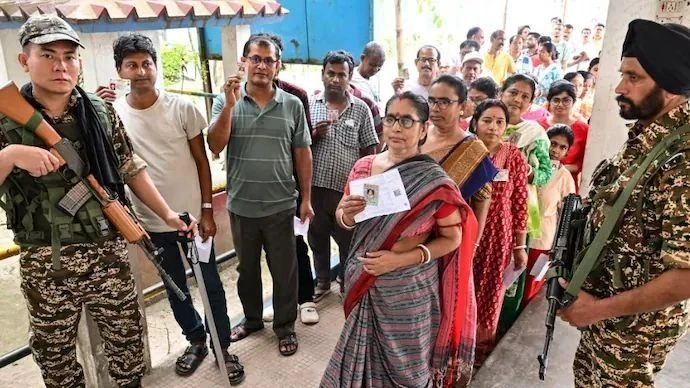
Despite the allegations of voter exclusion, West Bengal reportedly recorded unusually high voter turnout across multiple phases of the election. In several areas, turnout rates were described as exceptionally high, particularly in Muslim-majority constituencies where voters allegedly mobilized in large numbers.
Observers note that this turnout is being interpreted as a form of political expression and resistance by affected communities. In districts such as Murshidabad, reported participation rates were among the highest recorded in recent electoral history.
Election violence and political accusations add to unrest
The election period also witnessed reports of violence and unrest, including clashes at polling stations and allegations of intimidation. In some areas, incidents of attacks on political supporters were reported, further escalating tensions during the voting process.
Opposition leaders and critics have accused the ruling political framework of enabling an environment of exclusion and pressure, while supporters of the administration deny these claims and defend the integrity of the electoral process.
Broader debate over democracy and minority rights in India
The developments in West Bengal have contributed to a wider national and international discussion about minority rights, democratic practices, and institutional neutrality in India. Analysts argue that the controversy reflects deeper political polarization and competing narratives over citizenship, representation, and governance.
The situation continues to evolve as final election results are awaited, with political observers noting that outcomes in West Bengal may have significant implications for future national-level politics.