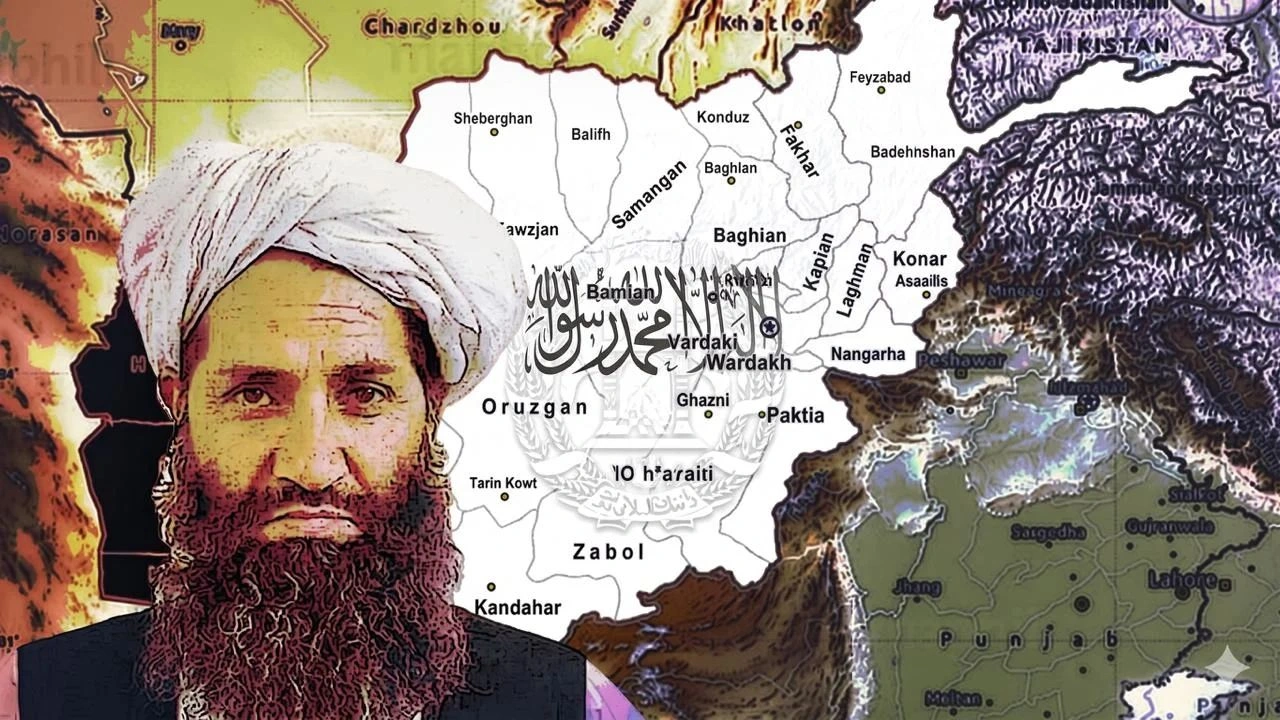
Kabul — A controversy has emerged following remarks attributed to the Taliban’s Supreme Leader Hibatullah Akhundzada, in which he reportedly called for unconditional obedience to himself, comparing it to obedience owed to Allah and the Prophet ﷺ. The statement has triggered internal disagreement among Taliban members and renewed debate over its religious validity.
According to reports, during a seminar in Kandahar on April 29, Hibatullah stated that obedience to him is obligatory in the same way as obedience to Allah and the Messenger ﷺ, and that disobedience to his orders carries the same level of sin. He further warned that past disobedience would be forgiven, but future violations of his directives would face strict punishment. He argued that refusal to follow his orders equates to disobedience to Allah and the Prophet ﷺ, citing the Quranic verse commanding obedience to Allah, the Messenger, and those in authority (Surah An-Nisa 4:59).
Scholarly Interpretation of “Those in Authority”
The claim has been challenged on theological and interpretative grounds, with scholars emphasizing that the concept of “Ulil Amr” (those in authority) in the Quran is not absolute or individually fixed.
Classical exegetes such as Imam Al-Alusi in Ruh al-Ma‘ani explain that “Ulil Amr” may refer to scholars of religion and knowledge, a view also reported from Ibn Abbas, Jabir ibn Abdullah, Mujahid, Al-Hasan Al-Basri, and Ata. Scholars describe them as those who derive and interpret rulings rather than impose personal authority.
Similarly, Imam Ibn Kathir, Al-Tabari, and Al-Suyuti transmit narrations from Ibn Abbas indicating multiple interpretations, including scholars, leaders of expeditions during the Prophet’s time, and Abu Bakr and Umar in specific contexts. This diversity of interpretation, scholars argue, shows that “Ulil Amr” is not a fixed individual designation.
Imam Fakhr al-Din al-Razi is also cited as preferring the interpretation that refers primarily to scholars, arguing that rulers themselves depend on religious scholars rather than the reverse.
Limits of Obedience in Islamic Teachings
Islamic tradition consistently limits obedience to authority. The Prophet ﷺ stated: “Obedience is only in what is right” (Sahih al-Bukhari 7145) and “There is no obedience to creation in disobedience to the Creator” (Mishkat al-Masabih 3696). These principles establish that obedience to any human authority is conditional and cannot override divine command.
Scholars argue that the Quran deliberately repeats “obey Allah and obey the Messenger” but does not repeat “obey those in authority,” indicating that their obedience is conditional, not absolute.
Criticism of Absolute Obedience Claims
Critics say that interpreting the verse to justify unconditional personal obedience reflects a misreading of Islamic texts and ignores the consensus of classical scholarship. They argue that such claims confuse governance with divine authority and contradict established principles of Islamic jurisprudence.
Historical examples are also cited, including the conduct of Caliph Abu Bakr (RA), who stated he should only be obeyed if he is on (truth), and Caliph Umar (RA), whose accountability was openly emphasized by companions.
Political and Religious Concerns
Observers note that if leadership claims are used to equate personal authority with divine obedience, it raises serious theological and political concerns. They argue that legitimacy in Islamic governance is not based on absolute obedience but on justice, accountability, and adherence to Sharia principles.
Critics further question the legitimacy of leadership claims themselves, pointing to the broader political context in Afghanistan and arguing that religious terminology should not be used to justify unchecked authority.
Conclusion
Religious scholars and analysts emphasize that obedience in Islam is rooted in divine law, not individual authority. While respect for leadership is required, it remains conditional and subordinate to the commands of Allah and the Prophet ﷺ. Any claim of absolute obedience, they argue, stands in clear contradiction to foundational Islamic teachings.