Pakistan has signed a multi-billion dollar defence export agreement with Libya, marking one of the largest weapons sales in the country’s history and placing it among the group of global arms exporters.
According to Reuters, the deal exceeds $4 billion and involves the sale of conventional military equipment to the Libyan National Army (LNA).
Officials described the agreement as historic in both size and financial impact.
A recent video showing Pakistan’s Chief of Defence Forces Field Marshal Asim Munir speaking with Libya’s military leadership has reinforced Pakistan’s defence confidence and diplomatic standing.
In the clip, Field Marshal Munir is heard saying that courage leads to victory and that Pakistan is ready to share its defence capabilities with its Libyan partners.
Analysts say the remarks reflect Pakistan’s evolving defence posture and its push to expand cooperation with friendly countries.
Just In!!
— HTN World (@htnworld) December 23, 2025
Pakistani Army Chief, Field Marshal Syed Asim Munir visited Benghazi, Libya, pledging full military and defense support.“Every defence capability we have is available for Libya. Any assistance you need will also be available at your doorstep,” he said.
He highlighted… pic.twitter.com/3eQYHFcvZc
Defence diplomacy and expanding exports
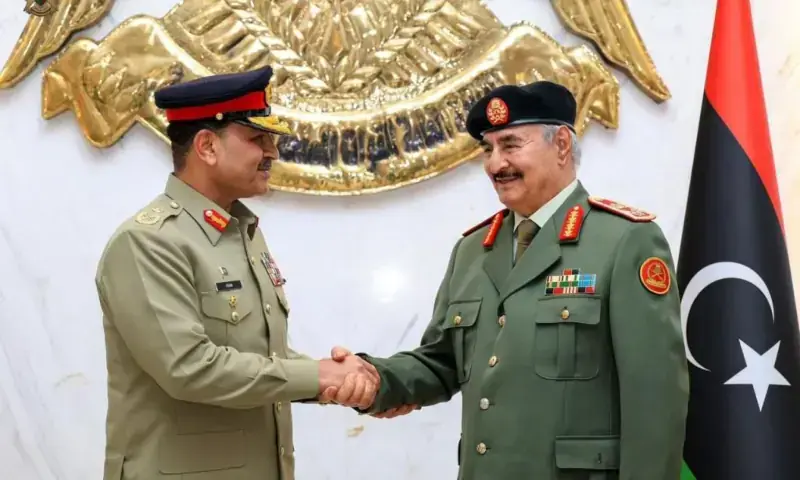
The agreement was finalized after a meeting in the eastern Libyan city of Benghazi between Pakistan’s Chief of Defence Forces, Field Marshal Asim Munir, and Saddam Khalifa Haftar, deputy commander-in-chief of the LNA.
While Pakistan’s foreign and defence ministries did not officially comment, military sources said the deal reflects Pakistan’s growing defence diplomacy and export ambitions.
Documents seen by Reuters indicate the package includes several JF-17 fighter jets, jointly developed by Pakistan and China, along with Super Mushak trainer aircraft used for basic pilot training.
A Pakistani official said the agreement also covers land, sea and air equipment with deliveries spread over nearly two and a half years.
The LNA’s official media confirmed a defence cooperation pact with Pakistan, including weapons sales, joint training and military manufacturing.
“We announce the launch of a new phase of strategic military cooperation with Pakistan,” Haftar said in remarks broadcast on Al-Hadath television.
UN embargo and economic context
Libya has remained under a United Nations arms embargo since 2011 requiring UN approval for weapons transfers.
However, senior Pakistani military officials described the embargo as a “paper restriction,” arguing that many Western and regional states have supplied arms to Libya for years despite it.
They said the agreement aligns with Pakistan’s policy of building an export-driven, self-sustained economy.
Libya remains divided between rival authorities, with the UN-recognized Government of National Unity controlling the west and the Libyan National Army holding the east and south, including major oilfields.
Pakistan has steadily expanded its defence exports, backed by a domestic industry that produces aircraft, armored vehicles, munitions and naval platforms.
Officials say rising exports are now central to economic revival plans, with the Libya deal seen as a major breakthrough for Pakistan’s defence sector.
Pakistan’s Army Chief, Field Marshal Asim Munir: “I am very hopeful that under the leadership of Field Marshal Haftar and my brother Saddam, Libya will once again reach the heights of glory it enjoyed in the past — and that this will happen very soon. My advice is to make your… pic.twitter.com/KRoo89hyix
— Libya Review (@LibyaReview) December 21, 2025
Shifting perceptions and regional credibility
Observers note that the viral video has also challenged long-standing narratives portraying Pakistan as diplomatically isolated.
Unlike earlier episodes reactions this time included positive commentary from non-Pakistani social media users, suggesting a shift in how Pakistan’s defence and foreign policy posture is perceived.
Political analysts argue that Field Marshal Munir’s direct and confident interaction with Libya’s military leadership underscores Pakistan’s relevance in the Arab and Muslim world.
It highlights Pakistan as a credible defence partner with practical capabilities rather than a passive actor.
Diplomatic sources say talks between Pakistan and Libya on defence cooperation, training and technical collaboration could expand further.
Read more: Turkish Intelligence Captures Senior Daesh Operative Linked to Global Suicide Plots