In the early 2000s, my afternoons followed a sacred ritual. The moment madrassa ended, I would race home to plant myself in front of the television by 5:30 PM sharp. Cartoon Network was about to air Dragon Ball Z in Urdu, and missing the opening sequence felt unthinkable.
On screen, Goku’s hair blazed golden as he battled evil Frieza, with their battle stretching across episodes. From the kitchen, my mother’s call about offering prayer would be met with my habitual lie: “bas das minute aur”– just ten more minutes. I, like millions of Pakistani children, stayed glued to the set until the end.
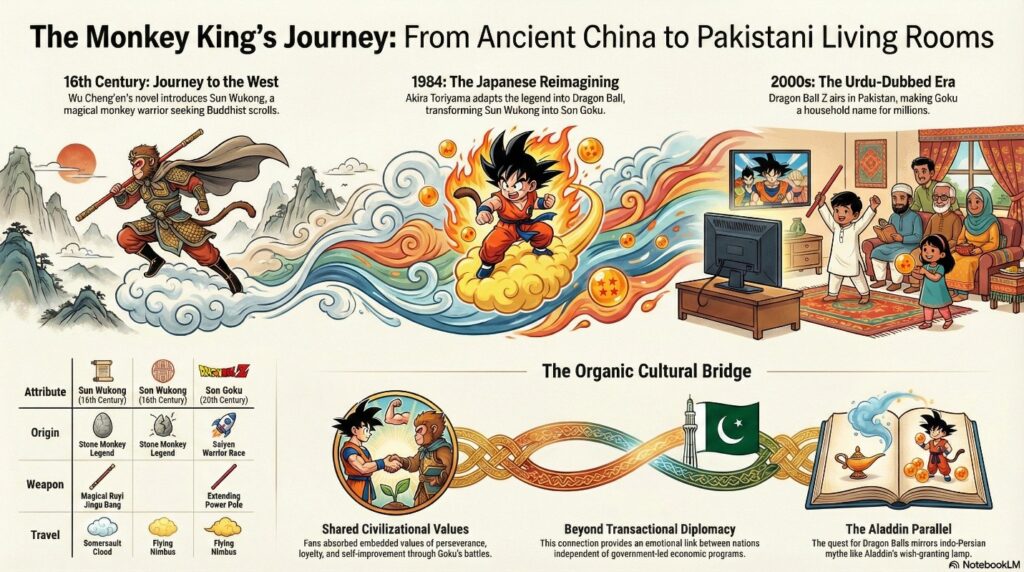
What none of us understood then was that this spiky-haired hero was a 16th-century Chinese legend wearing a Japanese disguise. In homes across Pakistan, Sun Wukong, the Monkey King, was quietly becoming the most influential figure in our childhood. We just knew him as Goku.
The legend began with Journey to the West, Wu Cheng’en’s 16th-century novel about a magical monkey born from stone, wielding a mighty staff and possessing supernatural powers. The story tells of a monkey warrior who accompanied monk Xuanzang on his journey to the west, present-day Indus Valley, the northern areas of Swat, Pakistan, to retrieve the original Buddhist scrolls and their teachings.
In 1984, Japanese manga artist Akira Toriyama reimagined Son Goku, the Japanese pronunciation of Sun Wukong, who inherited the monkey tail, the extending Power Pole, the rebellious spirit, and a flying nimbus, wrapped in a manga aesthetic that would circle the globe, with allusions to being from the warrior race of monkey-like creatures called Saiyans.
When Dragon Ball arrived in Pakistan via Cartoon Network in the late 1990s, it came stripped of context. No one explained the Chinese mythology or the Japanese adaptation. We just received Goku: a powerful fighter collecting magical orbs, speaking Urdu, and airing in the late afternoon.
The ancient narrative underlying every frame remained invisible. Toriyama had distilled Sun Wukong’s essence into universal themes of struggle and triumph, and combined them with the teachings of Shinto and Taoism. Yet, unknowingly, we Pakistani millennials were absorbing values deeply embedded in the original tale, which were perseverance, loyalty, and self-improvement through relentless discipline and purity of intention.
The series landed in Pakistan via cable TV’s Cartoon Network, which played its Urdu-dubbed version. After school, we’d see him train under impossible gravity or refuse to surrender against overwhelming odds, providing an unknowing archetype of resilience and never giving up.
When Goku rose, bloodied and exhausted, it felt like personal permission to keep trying against odds or seemingly insurmountable obstacles, come what may.
Our fandom thrived informally, without conventions or official merchandise. We debated power levels and super Saiyans in schoolyards, shared pirated DVDs, and later built Facebook groups for Urdu memes and episode theories. In a society that often dismissed animation as childish, Dragon Ball survived through genuine passion in silos and a long story arc that started in the 1980s and is continuing in 2025 as I am writing this.
This long arc of time has made Dragon Ball fandom spread across Gen X, millennials, and Gen Z alike.
Recently, in 2024, with Black Myth: Wukong, a Chinese video game that became a global phenomenon, Pakistani gamers suddenly noticed the familiar extending staff, the transformations, and the monkey imagery.
Social media erupted with awe-cum-recognition: “Wait, Goku is based on a Chinese character?” The invisible connection of our childhoods became undeniable. We had been engaging with Chinese mythology all along.
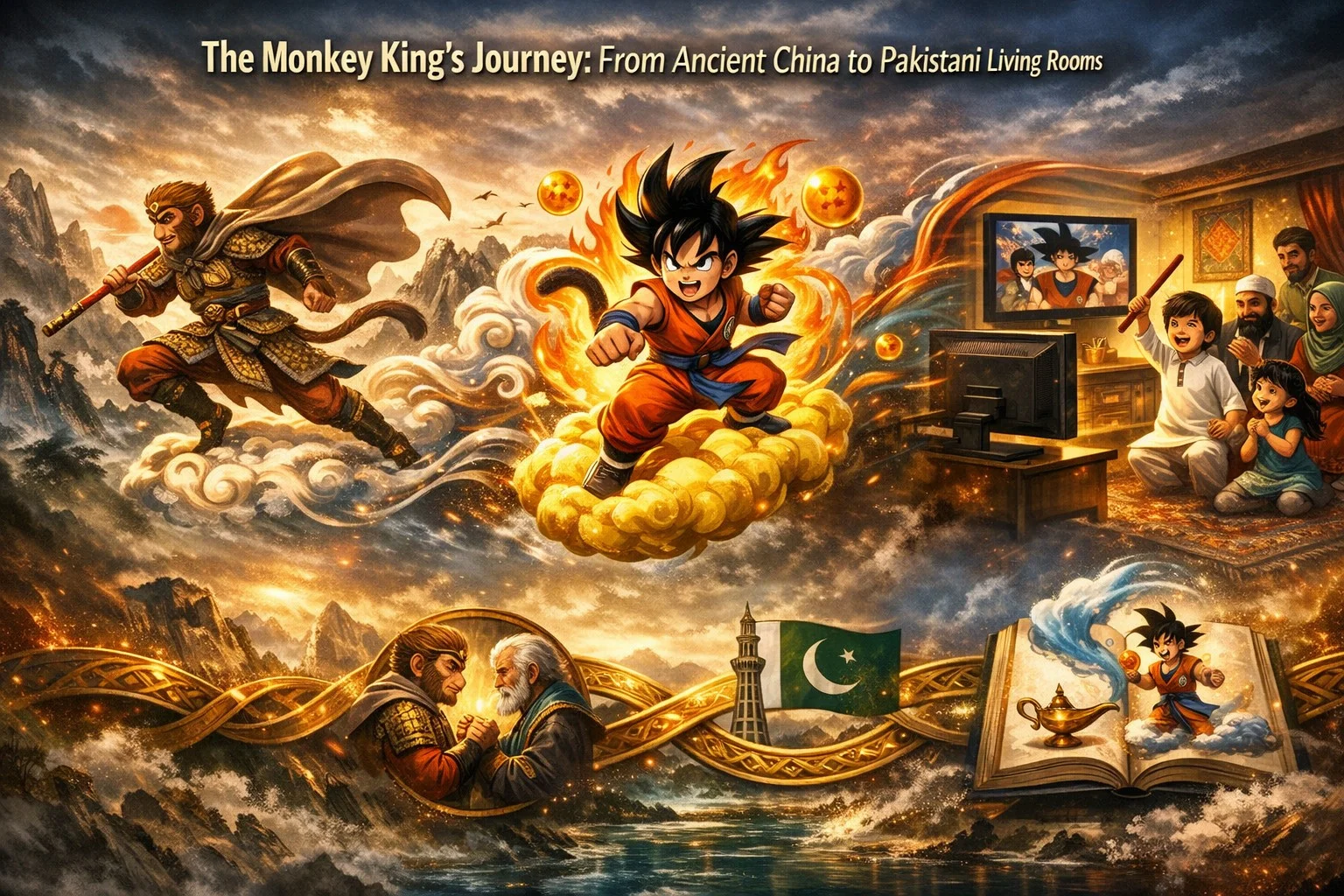
The revelation of this fact that one of China’s all-time epics was based on travels to the ‘west’, present-day Pakistan, frees the Pak-China connection from any political and diplomatic emphasis. This not only brings out a new dimension in the Pak-China historic connection but also reframes the bilateralism of today between the two countries, which is based on development/economic logic.
Dragon Ball represents something fundamentally different: a pre-existing, organic emotional connection to Chinese cultural narrative, built without a single government program or official initiative.
This hidden cultural bridge offers a genuine opportunity for collaboration beyond transactional relationships. Joint cultural events could trace Journey to the West’s evolution from Chinese opera to Japanese manga to Pakistani living rooms.
Pakistani millennials could share their personal investment in the saga, while Chinese youth explain Sun Wukong’s deeper cultural significance. Such exchanges would demonstrate how stories transcend borders while retaining their core meanings.
Moreover, civilizational parallels among the stories of the Indo-Persian heritage of the Indus and those of the Chinese and Japanese counterparts, something that even Xi Jinping has highlighted as part of his Global Civilization Initiative, can be found.
After all, what is a better way to initiate dialogue and common grounds between civilizations than shared stories? The story of Aladdin, the lamp, and the Genie that grants wishes is comparable in some ways to the story of Dragon Shenron from Dragon Ball, who is also summoned to grant wishes.
Similarly, the search for dragon balls and Aladdin’s lamp has been a recurring theme. This shows how stories can achieve what the calculated logic of politics cannot.
As we discover these historic connections, we are not merely learning about a foreign culture. We are recognizing a hidden depth in our own formative experiences. Sun Wukong traveled from 16th-century China through 20th-century Japan to 21st-century Pakistan, in a way that was subtle and organic, a cultural diffusion that appears invisible until it is not.
This journey, from ancient legend to cherished childhood memory, represents cultural exchange at its most powerful, that is, organic, meaningful, and rooted in genuine shared experience. The Power Pole that connected heaven and earth in Chinese mythology has, in its own way, connected Pakistani and Chinese youth across continents.
We just need to recognize the staff that the millennials have been holding all along, though unknowingly.
For years, we have not been able to see past the surface, but probing one simple childhood memory reveals a web of connections between different histories and cultures that sound strange, if not totally absurd at first. Every civilization has shaped itself around an overarching story, one that spans generations, borders, and even what we thought were impermeable boundaries between “us” and “them.”
The question isn’t whether these stories exist. It is whether we are still listening, and what we are willing to hear when they don’t fit the narratives we have been taught to expect.
It reminds one of a line from Journey to the West, that ‘a team of horses cannot bring back a word that leaves the mouth’. So is a good story, that once told, does not stop travelling.
Read more: Pakistan Moves to Strengthen Central Asia Trade Through QTTA and CPEC Routes