
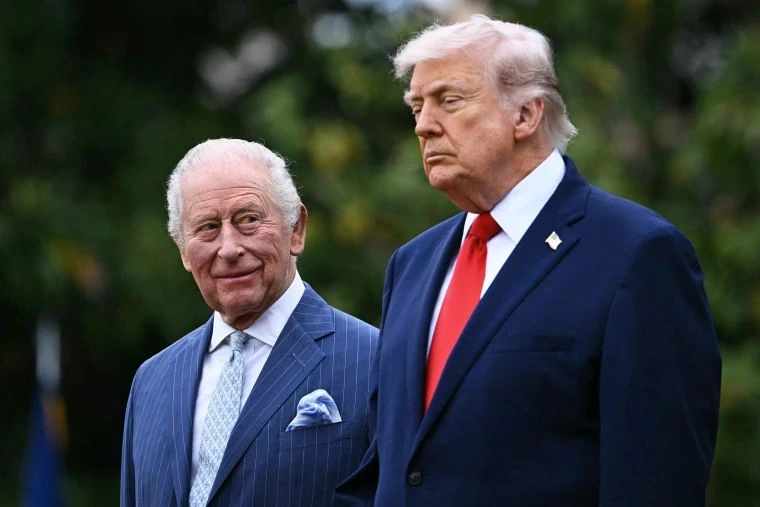
US President Donald Trump recently remarked that “if it were not for us, you would be speaking German,” to which King Charles reportedly responded, “and if it were not for us, you would be speaking French.” This exchange prompted reflection on what globalization truly represents—whether it is a genuine “global village” or merely a continuation of cultural and historical dominance under a new label.
The discussion raises a deeper question: is globalization truly about shared progress, or is it largely shaped by Western—particularly English-speaking—cultural supremacy? Is speaking English considered a standard of civility, while other languages are subtly downgraded or ridiculed? Such attitudes suggest that language is not merely a communication tool but also a symbol of cultural hierarchy and historical power.
Some argue that these remarks refer to historical wars between European powers, but even then, the broader implication remains significant: language often becomes a marker of civilizational dominance. Under the banner of globalization, certain values are presented as universal, yet critics argue these are largely extensions of Anglo-American cultural and commercial influence.
Events like International Labour Day on May 1 are often cited as examples of how a localized historical event (the Chicago labor movement) has been universalized and adopted globally as a cultural norm. Similarly, Western cultural celebrations such as Valentine’s Day and Halloween have been widely commercialized and exported, while traditions from other civilizations receive far less global recognition.
This raises concerns about selective globalization—where one cultural framework is promoted as universal while others are marginalized. Critics argue that any opposition to these imported cultural norms is often labeled as extremism or backwardness.
Historical figures like Lord Macaulay famously argued for the superiority of English literature over indigenous languages such as Urdu, Arabic, Persian, and Sanskrit. This mindset, critics say, laid the foundation for long-term cultural and educational dominance during colonial rule. Some historians also highlight how European scientific progress was influenced by earlier Islamic scholarship, though this contribution is often underrepresented in mainstream narratives.
From this perspective, globalization is seen not purely as integration, but as a continuation of cultural hierarchy shaped by historical power structures. The remarks by Trump and King Charles are therefore viewed by some as symbolic reflections of this deeper linguistic and civilizational dominance rather than casual historical references.











