
Delhi/Islamabad – Italian journalist Francesca Marino, whose commentary is frequently amplified by Indian media outlets including NDTV, has once again come under scrutiny, this time for renewing allegations linking Pakistan to recent security incidents while reviving her long-questioned claims about the 2019 Balakot airstrike.
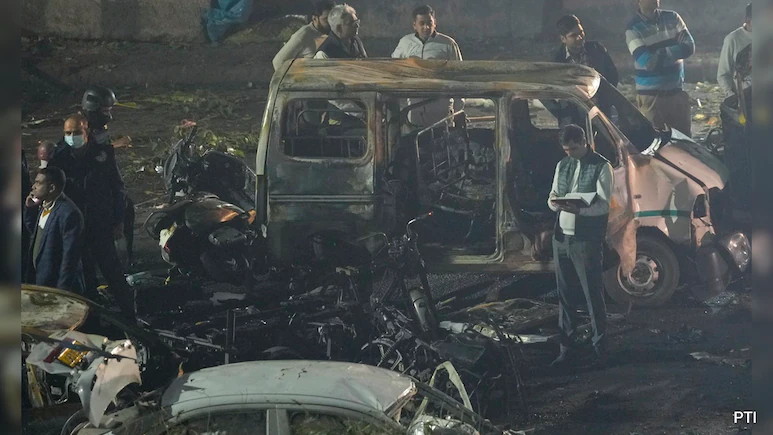
In a November 17 interview with NDTV’s Aditya Raj Kaul following the November 10 Delhi blast, Marino described the explosion as part of a “sustained terror blueprint.” The incident, which killed 15 and injured more than 20, was initially reported by eyewitnesses and first responders as a gas-cylinder malfunction inside a car. Within hours, however, the narrative shifted, with officials attributing the blast to Triacetone Triperoxide (TATP), the explosive known as the “Mother of Satan.” Marino used this shift to revive earlier insinuations of Pakistani involvement, mirroring the pattern of her Balakot commentary that has long lacked independent verification.
Marino has consistently claimed, relying solely on unnamed sources, that Pakistani authorities removed 35 bodies from the alleged Jaish-e-Mohammed facility targeted by Indian jets in Balakot. Her assertions sit uneasily beside India’s fluctuating official narrative, which began with claims of 300 militants killed, later changed to 350, then to an undefined “large number,” before settling on the statement that “we do not count bodies.” Her book, Balakot: From Pulwama to Payback, frames these allegations as investigative findings, yet depends almost entirely on anonymous testimonies and overlooks extensive on-ground reporting conducted by international media.
Within 48 hours of the strike, teams from BBC, Reuters, AFP, the New York Times, and Al Jazeera reached the site and reported no destroyed structures, no mass casualties, and only an injured villager. Satellite imagery reviewed by independent experts reinforced these findings, showing trees damaged but no significant structural impact. Despite this evidence, Marino’s account has continued to circulate within India’s media ecosystem as a supporting pillar for the Balakot narrative.
India’s shifting position became even more apparent after Pakistan’s retaliatory Operation Swift Retort, during which an Indian MiG-21 was shot down and its pilot captured. On the same day, India’s air defence mistakenly downed its own Mi-17 helicopter, killing six airmen and a civilian, a friendly-fire incident that received minimal domestic coverage and was formally acknowledged months later. Marino’s work, however, largely omits these events, reinforcing a one-sided portrayal of the episode.
Critics argue that her analysis routinely excludes key contextual details, including security lapses preceding the Pulwama attack, India’s inability to present satellite evidence or casualty lists to international bodies, and the absence of names of the alleged deceased militants. Questions have also been raised over the transparency of her sourcing, especially as her work often appears on lesser-known digital platforms and her professional background remains only partially documented.
Marino’s commentary, shaped from thousands of miles away, continues to echo New Delhi’s preferred narrative while offering no independently verifiable evidence. As India folds Balakot back into its current security discourse, her work underscores a broader dilemma in conflict reporting: the uneasy intersection of national storytelling, political alignment, and the journalistic duty to ground claims in demonstrable fact. In the absence of corroboration, analysts say the essential question remains: where does reporting end, and narrative reinforcement begin?











