
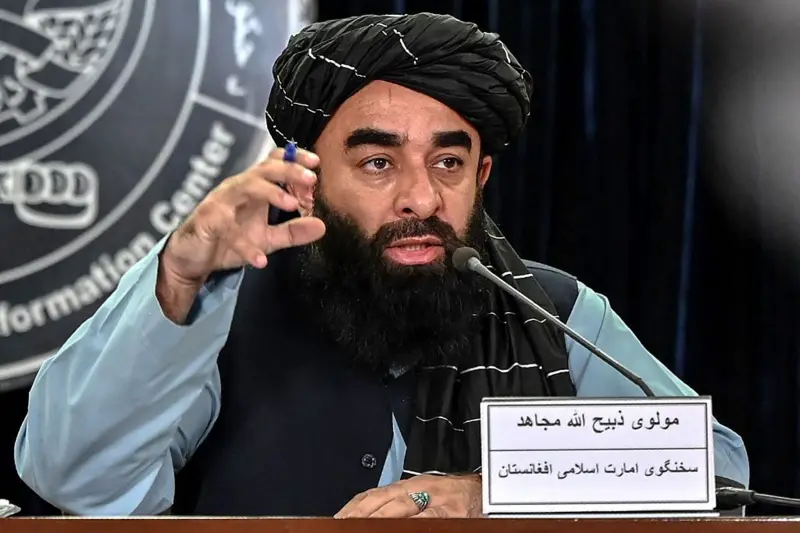
Taliban spokesperson Zabihullah Mujahid’s recent remarks to BBC Pashto and TOLOnews, claiming that Islamic State Khorasan Province (ISIS-K) operates from Pakistan and that arrests their stem from Taliban-provided intelligence, have triggered scrutiny across the region.
Verified arrests, intelligence-led operations, and United Nations monitoring assessments point in the opposite direction.
"Pakistan is partnering with us to confront ISIS,"
— HTN World (@htnworld) July 24, 2025
—Gregory D. LoGerfo, Acting U.S. Coordinator for Counterterrorism.
He stated that the U.S.-Pakistan partnership has yielded tangible results, including the capture of the Abbey Gate bomber — a significant breakthrough against… pic.twitter.com/gzN4qLFNF2
Pakistan has dismantled key ISIS-K nodes, while the group’s core presence and recruitment remain inside Afghanistan since August 2021.
Mujahid asserted that ISIS-K “nests” exist across the Durand Line and alleged support networks there.
Yet the Pakistani government has repeatedly documented arrests of senior ISIS-K figures whose roles were central to propaganda, recruitment, financing, and external-operations planning.
Those actions sit uneasily with any claim of sanctuary.
Read more!https://t.co/YV68x5if7U
— HTN World (@htnworld) December 18, 2025
Documented arrests undermine the sanctuary narrative
Recently, Pakistani authorities confirmed the arrest of Sultan Aziz Azam, ISIS-K’s chief propagandist and founder of the Al-Azaim Foundation.
Azam had served as the group’s public voice since 2015 and was notorious for claiming responsibility for the 2021 Kabul airport bombing.
A subsequent UN assessment noted that silencing this media hub significantly degraded ISIS-K’s ability to coordinate messaging and external attacks.
Another high-profile case followed through international cooperation.
A joint operation led to the capture of Ozgur Altun, also known as Abu Yasir al-Turki, a senior ISIS-K media and logistics figure involved in transferring operatives from Europe and Central Asia into the region.
His detention disrupted facilitation pipelines that are incompatible with allegations of tolerance or protection.
Operational facts matter.
If ISIS-K were based in Pakistan, its top propagandists and facilitators would not be apprehended there, nor would the group’s propaganda infrastructure show measurable degradation after Pakistan-side arrests.
The record shows dismantlement, not shelter.
Breaking:
— HTN World (@htnworld) June 1, 2025
A top-level ISIS recruiter, Özgür Altun, alias Abu Yasir Al-Turki, was captured at the Pakistan-Afghanistan border while trying to cross into Pakistan, in a joint operation by Turkey’s MIT & Pakistan’s ISI.
Altun, listed in the orange category of wanted terrorists. pic.twitter.com/AH7YRxThns
UN monitoring contradicts Kabul’s claims
The United Nations’ Sixteenth Report of the Analytical Support and Sanctions Monitoring Team assessed that Taliban assertions denying terrorist activity from Afghan territory are “not credible.”
The report states that while the de facto authorities have “suppressed—although not eliminated—the threat” from ISIS-K, the group “continues to pose serious threats within Afghanistan, regionally and beyond.”
Deflection is not enforcement. ISIS-K expanded in eastern Afghanistan after August 2021 amid security gaps. Furthermore, shifting blame “across the Durand Line” avoids accountability for recruitment, training, and movement occurring under Taliban rule.
Regional credibility depends on transparency, names, timelines, and outcomes not uncorroborated accusations.
Pakistan’s counterterror record against ISIS-K is documented and verifiable. Mujahid’s assertions remain political claims without supporting evidence.
Read more: Turkish Intelligence Captures Senior Daesh Operative Linked to Global Suicide Plots











