
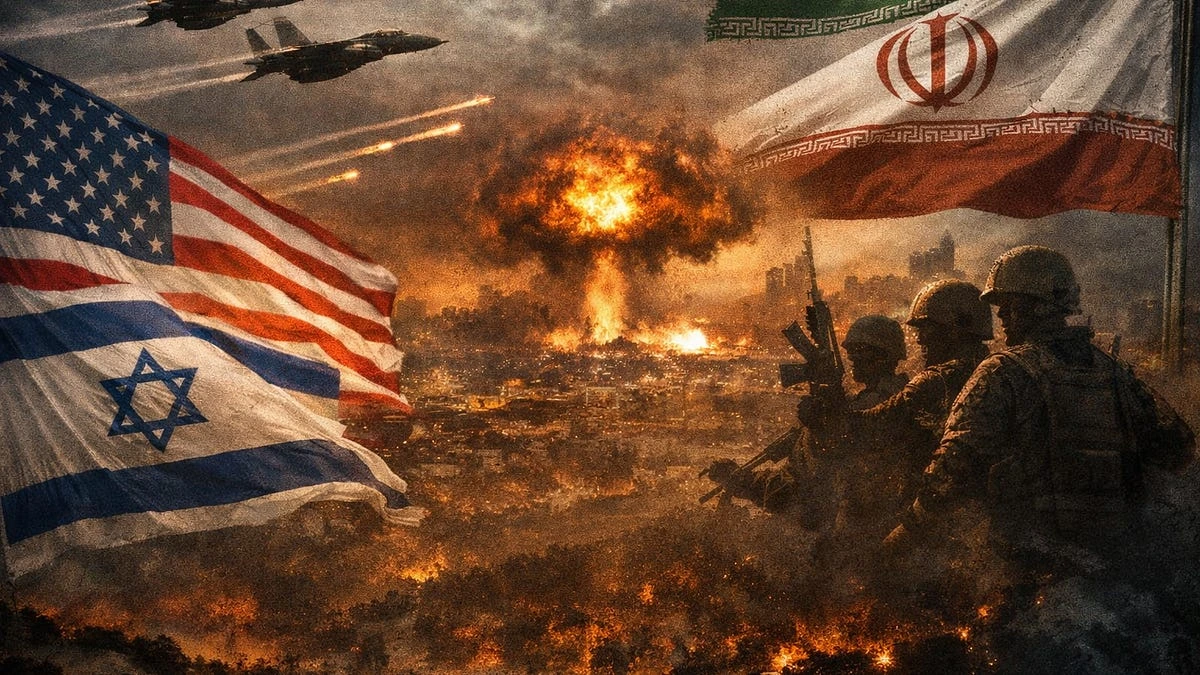
News headlines are rarely innocent. They are the first and often the only thing millions of readers encounter about a conflict, and in that single line of text, enormous political work is done silently. The verb chosen, the actor placed first, the quotation marks used or withheld are not stylistic preferences. They are ideological decisions. The way Dawn, BBC, CNN, and Al Jazeera covered the Iran-US conflict between June 2025 and April 2026 was not simply different journalism. It was the production of entirely different worlds.
The Grammar of Power
Consider a deceptively simple contrast. When the United States struck Iranian nuclear facilities at Isfahan, Fordow, and Natanz in June 2025, CNN and BBC headlines consistently placed the US as a technical actor executing precise actions, while Iran appeared as a threat, a retaliator, or a passive recipient. Dawn told a structurally different story. Its March 2026 headline, “Iran hits back, targets Israel, US bases,” gave Iran full grammatical agency through two active verbs, presenting the same events as a legitimate military response. This is not merely a matter of perspective. It is a matter of whose violence gets naturalized and whose gets named.
Language is not a window onto the world. It is one of the primary mechanisms through which power is upheld or challenged. When headlines routinely assign active verbs to Western military actors and passive constructions to their targets, a political worldview is reproduced without anyone having to argue for it. It simply feels like grammar. And that is precisely what makes it so effective.
Diplomacy Buried, Sovereignty Erased
Perhaps the most troubling pattern concerns what was left out entirely. When US and Israeli forces struck Iran despite active negotiations, CNN and BBC framed the strikes as military operations in isolation, stripping away the diplomatic context completely. Dawn’s headline was unambiguous: “The US and Israel struck Iran despite progress in negotiations.” The word “despite” does the heaviest lifting here. It places moral accountability directly on Washington and Tel Aviv without requiring a single editorial comment. Western outlets simply did not produce anything like it.
The BBC’s use of quotation marks around Trump’s claim that Iranian nuclear sites were “obliterated,” immediately placed against contradictory intelligence findings, represents a subtler operation. It questioned without editorialising. It delegitimised without abandoning impartiality codes. This is more sophisticated than simple advocacy, and considerably harder to detect.
Al Jazeera and the Words That Were Not Chosen
Al Jazeera’s most significant editorial choice was one of vocabulary. Where Western outlets reached for sanitised alternatives, Al Jazeera deployed the word “genocide” in headline contexts covering the conflict’s civilian toll. That single lexical decision reflects a deliberate refusal to reproduce the official Western political vocabulary that softens the reality of what was happening on the ground. Western outlets did not use that word. That silence is itself a political act, and its consequences for how global audiences understood the human cost of the conflict are real.
Where CNN and BBC hedged through institutional attribution, “US says its strikes degraded Iran’s nuclear program by one to two years,” Al Jazeera placed the attribution at the front of the sentence, signalling that what followed was a claim rather than a confirmed finding. The phrase “US says” refuses to naturalise the official version. It keeps the reader at a critical distance. Most Western headlines did not.
Reading Between the Lines
Edward Said observed decades ago that Western media has long depicted Muslim states as irrational, dangerous, and in need of correction. Those patterns did not disappear in 2025 and 2026. Iran was still framed as the primary threat. Western military action was still represented as a response rather than a cause. The leaked Defense Intelligence Agency report forced a degree of uncertainty into even the most institutionally loyal coverage, but epistemic doubt is not ideological transformation.
The same conflict produces genuinely different realities depending on where you read about it. Western coverage creates one map in the reader’s mind. Dawn or Al Jazeera creates another. Both maps are incomplete. But only one of them is presented as neutral. For anyone serious about understanding international conflict rather than simply consuming it, that asymmetry deserves far more attention than it gets.
Read More: Pakistan Intensifies Mediation Efforts Between Washington and Tehran as Mohsin Naqvi Arrives in Iran











