
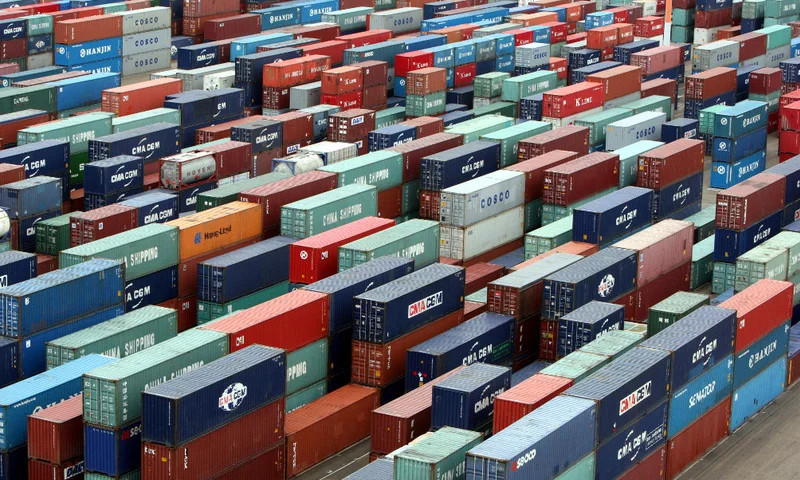
The government has allowed the re-export of transit cargo stuck at Pakistani ports to protect Afghan importers from rising demurrage charges, as the suspension of transit trade with Afghanistan drags on with no clear end in sight.
The decision comes after importers requested a one-time waiver for more than 6,500 containers stranded at Karachi ports since the Pak-Afghan border closed on October 11, 2025.
The border closure followed a sharp rise in tensions between the two countries, mainly over the banned Tehreek-i-Taliban Pakistan (TTP).
After talks collapsed in November, Afghanistan suspended trade ties, and Pakistan had already shut the border after clashes in October. Since then, the movement of transit cargo has almost stopped.
Officials at the Ministry of Commerce said they have started issuing permission letters to importers on a case-by-case basis.
Although no formal announcement has been made, the process is already underway.
Around 3,000 of the stranded containers carry palm oil from Malaysia meant for Afghanistan. Cargo from China and Vietnam also makes up a large share of the backlog.
Most of the containers are stuck at Karachi ports, while only 600 to 700 are held near the Chaman and Torkham borders.
After foreign diplomats raised concerns, the government decided to allow re-export so importers can use other routes or ports.
Earlier, Pakistan allowed limited humanitarian consignments to move, but most cargo remains blocked.
The crisis has badly hurt transit trade, which has already fallen from $6.7bn in FY23 to $1.01bn in FY25. With trade still suspended the figure may drop below $1bn this year.
However, Pakistan has reported a significant shift in its security landscape following the restriction of cross-border trade and movement with Afghanistan.
According to the Director-General of Inter-Services Public Relations (DG ISPR), a majority of the major terrorist incidents occurring in Pakistan over the past year were traced back to Afghan nationals.
These findings have intensified national security concerns and prompted a re-evaluation of border management and bilateral trade policies.
Read more: From Maduro’s Arrest to US Court Proceedings











