
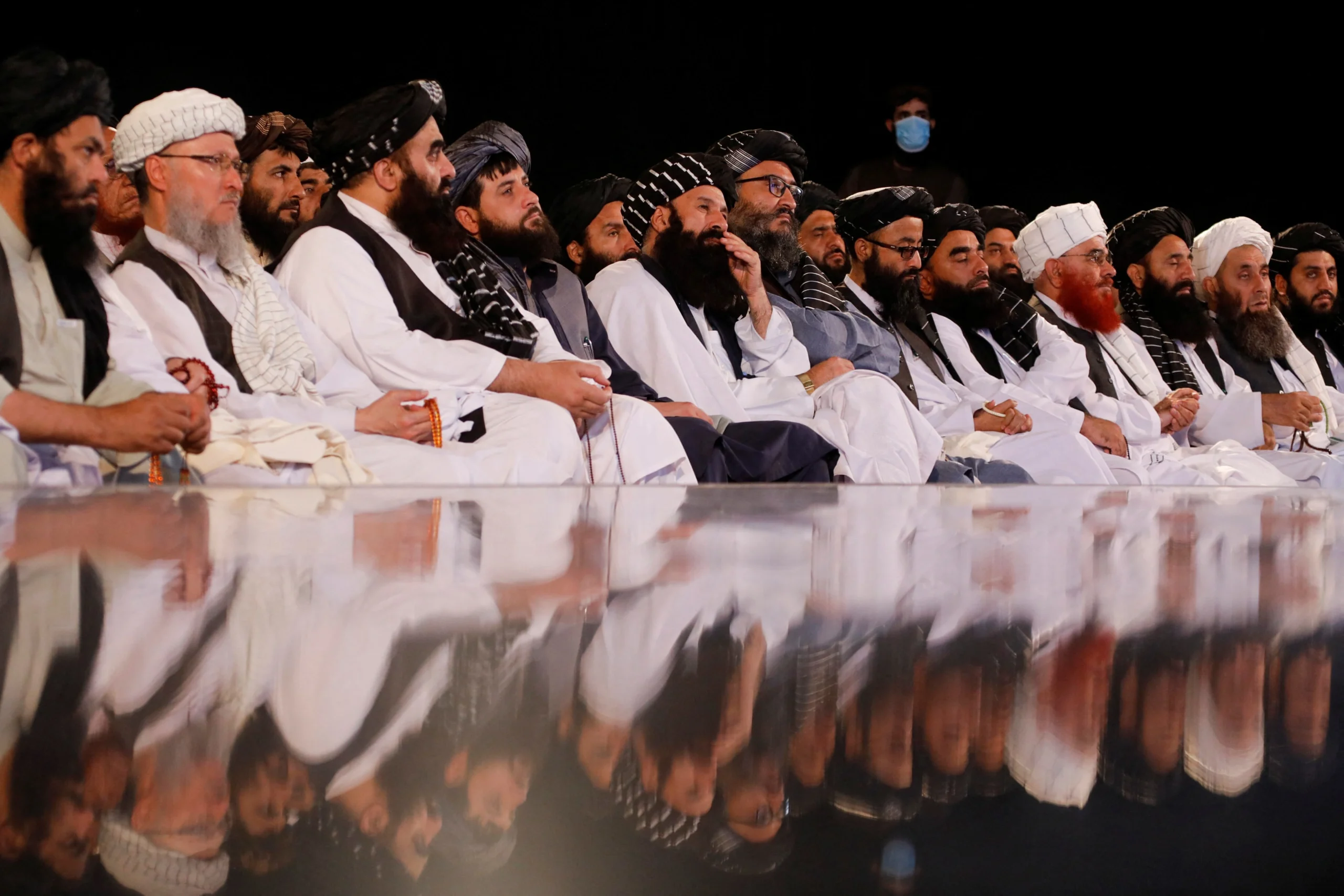
A recent study on the current system of governance in Afghanistan has sparked a new debate over whether this system is truly based on the principles and methodology of Islamic Sharia, or whether it is in fact a modern form of absolute monarchy presented under the guise of religion. According to the report, Afghanistan currently does not have a single coherent and organized government; rather, a complex “parallel governance structure” is operating, which has reduced the administration in Kabul to merely a personal entity, while all real power is concentrated in Kandahar in the person of Hibatullah Akhundzada. This style of governance reflects a personalized system where religion is used merely as a justification for control, rather than a traditional state structure.
The study reveals that the Taliban system has effectively split into two parallel centers, in which Kandahar completely dominates the administration in Kabul. All major ideological and strategic decisions are made by Mullah Hibatullah Akhundzada and his selected circle of clerics, while cabinet ministers based in Kabul are limited to handling routine administrative affairs. The effects of this division have now started to become visible, as pragmatic leaders in Kabul who remain in contact with the international community appear dissatisfied with the hardline decisions coming from Kandahar. This internal friction indicates that a deep gap has emerged within the movement between “command authority” and “administrative necessity.”
In Islamic history and Sharia, the principle of “Shura” (consultation) holds central importance, but the current Taliban system has taken the form of an “absolute monarchy.” In this system, all key appointments and policies are decided not through collective consultation but through direct verbal orders or decrees issued by the so-called Amir-ul-Momineen. Even the concept of allegiance (bay‘ah) has lost its original spirit and value; the pledges taken from tribal elders and clerics are no longer a religious act but have become a politically enforced commitment, where deviation may carry serious consequences. Researchers describe this system as “religious authoritarianism,” where the ruler is not accountable to any individual, institution, parliament, or public forum.
In terms of representation, this system has also failed to reflect Afghanistan’s multi-ethnic society. Approximately 58 percent of the non-Pashtun population, including Tajiks, Hazaras, and Uzbeks, is completely excluded from real centers of power. All authority is concentrated in a specific Kandahar-based ethnic leadership, which reinforces the idea of “ethnic dominance” rather than national unity. A few non-Pashtun faces in the cabinet are included merely for display to the international community, and they have no real financial or administrative autonomy. Instead of inclusion, this hierarchy has pushed Afghan society toward a dangerous level of deprivation and ethnic division.
The Taliban system has turned into a tool of “ideological uniformity” and “social control” rather than the delivery of justice. The deliberate ambiguity in laws provides protection to the powerful class, while ordinary citizens are subjected to the harshest punishments and strict surveillance. The level of intellectual suppression is such that any form of dissent is labeled as “rebellion” and crushed, replacing dialogue with fear and thought with blind obedience. While Islam promotes intellectual diversity and justice, this system has imposed a rigid and one-dimensional interpretation, turning religion into a means of pressure and silence.
The result is that the Taliban system has moved away from the true spirit of Sharia—justice, equality, and consultation—and has transformed into an oppressive personalized authority. This system is based not on public consent but on threat and force, pushing the country toward economic collapse, social backwardness, and international isolation. The attempt to legitimize power in the name of religion is not only a tragedy for the Afghan people but also distorts the concept of Islamic governance at the global level. It is a system where fear is prioritized over faith and personal will over justice.











