
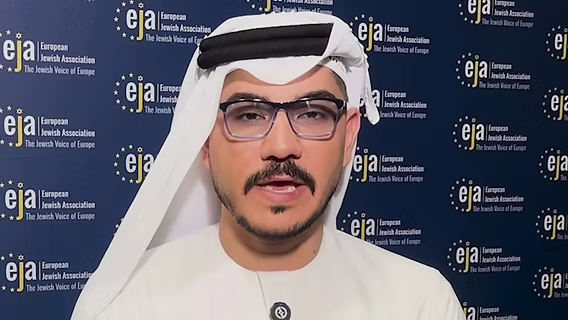
A new online debate has emerged after statements by commentator Amjad Taha regarding Pakistan’s diplomatic role in the Middle East. His remarks have sparked strong reactions on social media, where different groups are presenting sharply different views about his position and intent.
Some users and analysts argue that his comments reflect a clear bias in favour of certain regional positions. They say his statements appear critical of Pakistan’s efforts to promote dialogue and reduce tensions in conflict affected areas. As a result, the discussion has quickly turned into a wider debate about media influence and narrative shaping during times of regional conflict.
Meanwhile, supporters of Pakistan’s foreign policy have defended the country’s consistent stance on peace and negotiation. They highlight that Pakistan has repeatedly called for diplomatic solutions rather than escalation. In this context, they view criticism of its mediation efforts as unfair and politically motivated.
For the third time, Pakistan failed. Islamabad is no place for talks. It has never been neutral and has far too much in common with the Islamic regime in Iran. The Arab lobby delivered. Thank you, Trump, for canceling Witkoff and Kushner. You saw the regime’s weakness when it…
— Amjad Taha أمجد طه (@amjadt25) April 25, 2026
Social Media Reactions Highlight Divided Views and Information War Concerns
In addition, the controversy has gained momentum on digital platforms, where users are sharing contrasting interpretations of the same statements. Some posts claim that external actors often try to influence regional opinion through online messaging. Others argue that such claims risk oversimplifying complex geopolitical realities.
Transitioning from online debate to broader concerns, analysts note that the situation reflects a growing “information war” in which narratives play an important role alongside traditional diplomacy. They stress that in such environments, unverified claims can spread quickly and shape public perception.
Furthermore, observers say that the focus should remain on diplomatic engagement rather than personal accusations. They emphasize that regional stability depends on dialogue, not escalation through media narratives.
In conclusion, the ongoing debate shows how sensitive geopolitical discussions have become in the digital age. While opinions remain divided, the central issue continues to be the search for stability in a region already facing multiple challenges.











