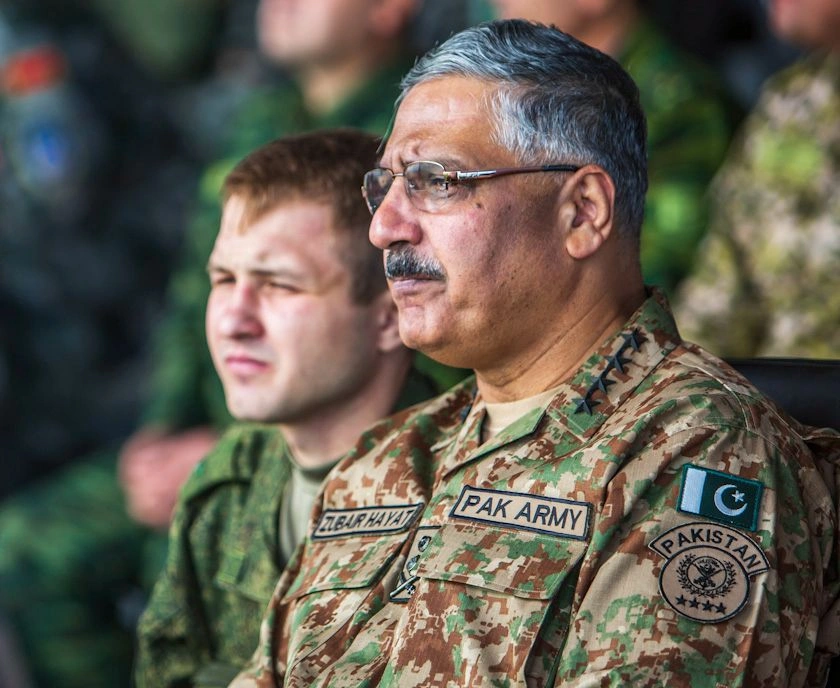
Speaking at the book launch ceremony of “Marka-e-Haq: Deterrence, Provocation and Strategic Maturity in South Asia” in Islamabad, former Chairman Joint Chiefs of Staff Committee, Lt Gen (R) Zubair Mahmood Hayat, emphasized that a fact-based dialogue is essential to understanding deterrence, balance of power, and strategic stability in South Asia.
He said that in the region, miscalculations often travel faster than reason, making responsible behaviour and strategic restraint a critical necessity. He noted that the book presents a bold and clear assessment of regional risks, policy failures, and emerging security challenges.
According to him, over the past decade, an attempt was made to impose a so-called “new normal” in South Asia, but it has instead evolved into what he described as a “new abnormal situation.” He argued that India’s strategic and military doctrine has failed to achieve its intended objectives, stressing that no unilateral “new normal” can be established in the presence of Pakistan.
Lt Gen (R) Hayat said that over the past 25 years, India has repeatedly engaged in provocative actions, but each time it has faced failure due to Pakistan’s strong and effective deterrence posture. He added that India’s so-called Modi Doctrine is based on flawed assumptions that have repeatedly pushed the region toward heightened tensions, including the risk of nuclear escalation.
He also criticized what he termed India’s Hindutva-influenced strategic outlook and the role of “Godi media” in fuelling hostility and regional instability. He warned that such policies could have serious consequences for regional peace and security.
Reaffirming Pakistan’s position, he said the country remains committed to a full-spectrum deterrence policy, which continues to serve as a stabilizing factor in South Asia. He added that Pakistan possesses the capability to manage escalation dynamics effectively, while modern strategic communication has also become a key element of national power.
Highlighting key flashpoints, he said Kashmir and water disputes remain the two most dangerous nuclear flashpoints in the region, requiring restraint, dialogue, and responsibility. However, he alleged that India’s aggressive posturing continues to undermine peace efforts.
Concluding his remarks, Lt Gen (R) Zubair Mahmood Hayat said that while narratives and doctrines may evolve over time, truth remains constant. He warned against underestimating Pakistan, stating that it is a serious misjudgment to perceive the country as weak.