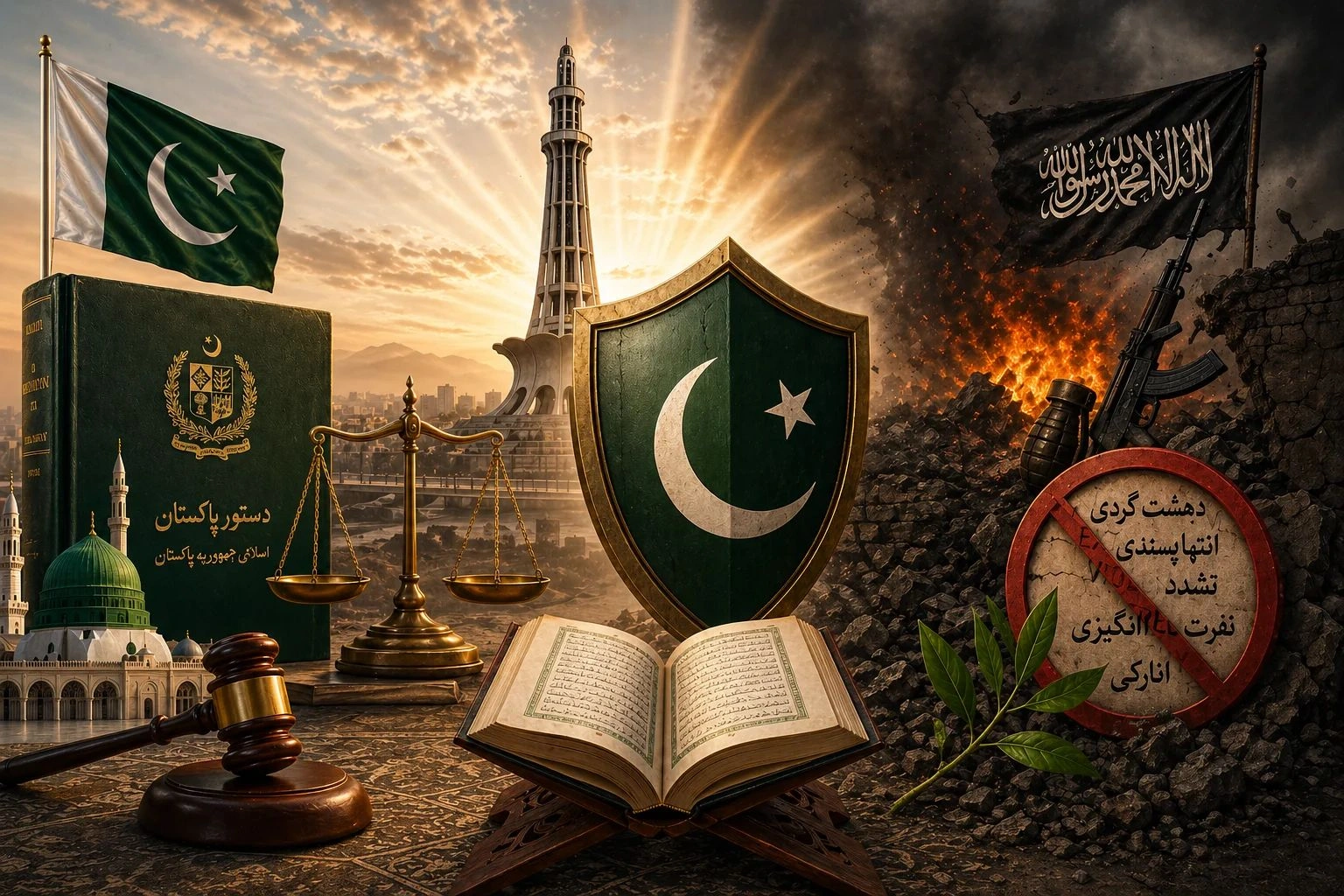
The State of Pakistan is not merely a geographical entity but an ideological Islamic republic, founded on the firm belief that sovereignty belongs solely to Almighty Allah and that authority is a sacred trust. Article 227 of the Constitution of Pakistan ensures that no law can be enacted that is repugnant to the teachings of the Holy Quran and Sunnah. When the state system itself is grounded in Islamic principles, violent actions carried out by extremist groups cannot be classified as “jihad”; rather, they fall under clear categories of rebellion and fasad fil-ardh (corruption on earth).
Misuse of “Kufr-e-Bawah” and Khawarij Narrative
Terrorist groups attempt to justify armed rebellion against the state by invoking the concept of “kufr-e-bawah,” which scholars describe as a distorted and invalid interpretation. In Islamic jurisprudence, this term refers only to clear, undeniable disbelief supported by absolute proof. According to Imam Nawawi, rebellion against a ruler is only permissible if there is explicit and undeniable proof of such disbelief. Renowned contemporary scholar Mufti Muhammad Taqi Usmani has also stated that shortcomings in implementing Islamic law do not amount to kufr-e-bawah, and as long as a state recognizes Islam as its official religion, taking up arms against it remains prohibited.
Guidance from Prophetic Traditions
Islamic history records the emergence of the Khawarij, who declared Muslims as unbelievers and legitimized their bloodshed. Authentic hadith describe them as people who would appear in later times, young in age and lacking understanding of religion (Sahih Bukhari 5057). They would exit Islam as an arrow passes through its target (Sahih Muslim 1064), highlighting their deviation from the true teachings of Islam.
Scholarly Consensus Across Generations
Islamic jurists across centuries have consistently ruled against rebellion. Imam Abu Hanifa considered armed rebellion against the state as “baghi” (rebellion), which must be dealt with by the state. Imam Ibn Taymiyyah described the Khawarij as those who declare Muslims as disbelievers over sins and justify their killing. Classical scholars such as Allama Shami and Shah Waliullah Dehlawi emphasized that state stability is essential for the preservation of religion, and rebellion leads to widespread disorder.
Modern Scholarly Position
Contemporary scholars, including Mufti Taqi Usmani, Mufti Rafi Usmani, and others, have categorically rejected terrorism. They state that in a country where Islamic law forms the basis of governance, armed struggle against the state is unlawful. Maulana Maududi emphasized that change within Muslim societies must occur through peaceful and constitutional means, not through armed groups. Similarly, Yusuf al-Qaradawi stated that indiscriminate violence and takfir are characteristics of extremist deviation.
Paigham-e-Pakistan Consensus Fatwa
In 2018, more than 1,800 leading scholars from all schools of thought in Pakistan issued the historic “Paigham-e-Pakistan” declaration. This unified religious verdict states that armed rebellion against the state is forbidden, suicide attacks are haram, and the declaration of jihad is the exclusive authority of a legitimate Islamic state.
Prominent scholars endorsing this declaration include Mufti Taqi Usmani, Mufti Rafi Usmani, Maulana Fazlur Rehman, Mufti Munib-ur-Rehman, Dr. Muhammad Tahir-ul-Qadri, Prof. Sajid Mir, Allama Sajid Naqvi, and others representing Deobandi, Barelvi, Ahl-e-Hadith, and Shia schools of thought. All unanimously declared extremist groups as following the ideology of the Khawarij.
Sanctity of Human Life in Islam
Islam places the highest sanctity on human life. The Quran declares that killing one innocent person is equivalent to killing all humanity (Al-Ma’idah 5:32). The Prophet Muhammad ﷺ strictly prohibited the killing of women and children even during warfare (Sahih Bukhari 3015). In contrast, terrorist groups targeting mosques, schools, and markets are engaging in fasad fil-ardh, which is strictly prohibited and punishable in Islam.
Conclusion
Evidence clearly shows that the actions of extremist Khawarij-linked groups have no connection with Islam. These organizations exploit religious language to serve political agendas and external influences. Pakistan’s Islamic constitution and the teachings of Sharia both clearly reject terrorism. Protecting the state, safeguarding innocent lives, and rejecting extremist ideology remain both a national duty and a religious responsibility for every citizen.