
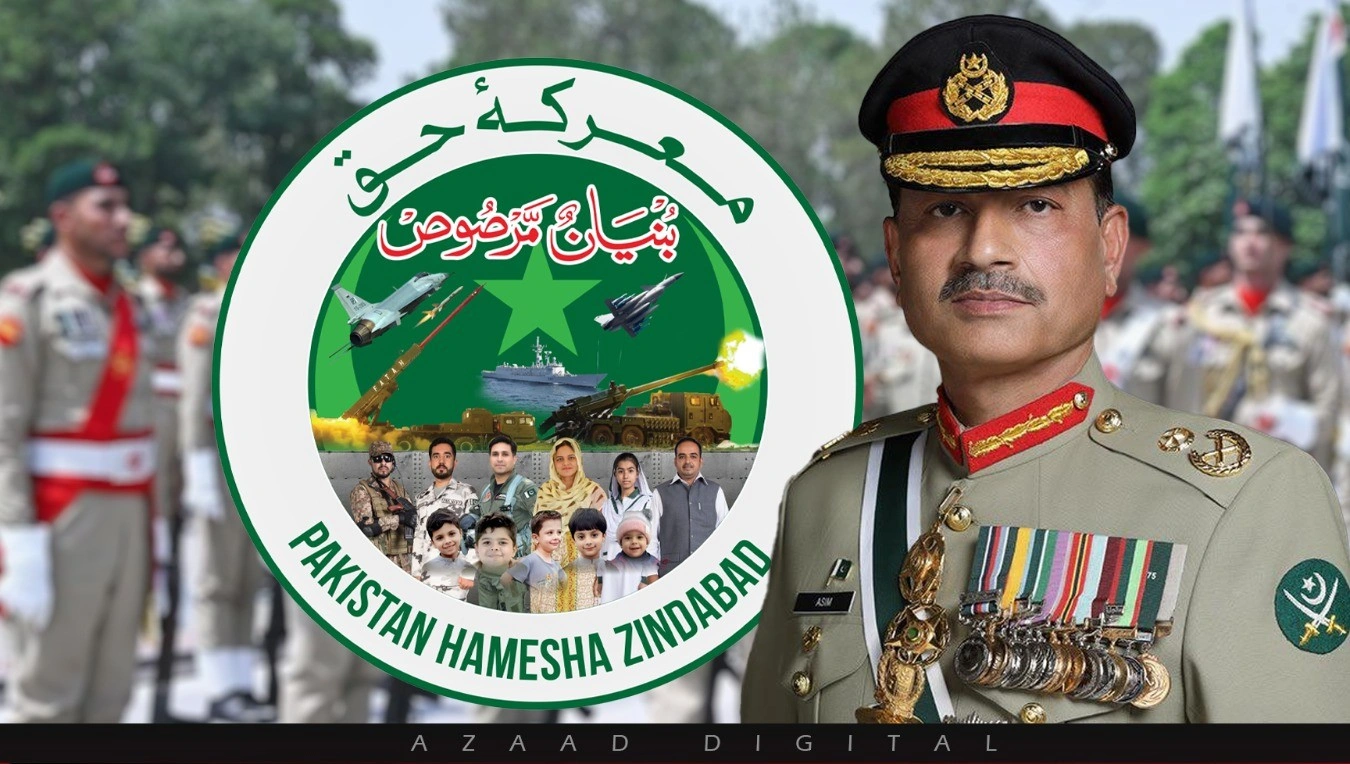
We are not reckless like India, driven by blind rage. We are a responsible state. Even in war, we do not fall into brutality. We choose our targets carefully and act with responsibility. We do not target civilians. We locked onto their highest military leadership and sent them the video as proof. Our drones kept flying over the Indian prime minister’s residence.
The Battle of Haq is a major success for Pakistan. It is an extraordinary success that turned the strategic balance of South Asia upside down. If you replace the words “South Asia” with “the world,” it would still not be an exaggeration. In moments, Pakistan changed the rules of warfare and the way gains and losses are calculated. Let us understand this in the right context. Let us see what actually happened and what Pakistan truly changed.
Have you ever thought about how India dared to attack Pakistan? What calculation pushed India toward this mistake? Pakistan is a nuclear power. India and Pakistan are neighboring countries. They are not like Iran and Israel, separated by distance and other countries in between. Here, by the time a missile launch is detected, the target can already be hit. How far is Lahore from Delhi?
There was another serious danger as well. That was the nuclear threshold. This is the point when a country feels it must use nuclear weapons for its survival. In other conflicts, this threshold can be delayed for weeks or months. But in a Pakistan-India war, this stage could arrive in less than a week. Despite this risk, India still attacked. Why did it do so?
Until we answer this question, we cannot fully understand what Pakistan’s brave armed forces achieved last May. My own knowledge is limited, and I am sharing my view based only on available information. Even so, when the Battle of Haq is mentioned, it fills the heart with pride. The more one understands this event, the more one admires Pakistan’s military skill. If Donald Trump does not get tired of praising Pakistan, it is not without reason. It is an acknowledgment of a victory that changed the rules of war and destroyed old assumptions.
Now let us understand India’s calculations. They were quite clear and had several parts.
First, India believed Pakistan’s economy could not handle a war. For years, there has been talk of bankruptcy. India thought a country in such a condition could not fight.
Second, India believed that Pakistan was deeply divided politically. It thought that information warfare had weakened national unity. India assumed that in case of war, Pakistan’s people would not stand together, making it easier to pressure the country.
Third, India had already increased terrorism through proxies in two of Pakistan’s provinces. It believed Pakistan’s army was tied down on the western borders and would not be able to engage India in the east.
Fourth, India believed it had the backing of Israel and its military strength. Everyone knows what Israeli support usually means. India assumed that Pakistan would stay silent under such pressure.
Based on this thinking, India believed it could attack Pakistan and face no serious response. It wanted this to become a new normal. Just as Israel attacks neighboring countries whenever it wants, India hoped it could carry out limited actions against Pakistan at will. The Indian leadership believed that the dominance Zionism enjoys in the Middle East would be mirrored by Hindutva in South Asia. In this plan, Pakistan’s nuclear deterrence would become meaningless.
This was a very dangerous situation. Pakistan’s response had to be carefully chosen. Whether it chose compromise or resistance, the effects would last for decades.
Then Pakistan responded, and it responded in a way that echoed across the world. Pakistan’s armed forces emerged victorious, and with them, the entire nation stood proud. This also needs to be understood in the right context.
A few years ago, Modi had claimed that if India had Rafale jets, Pakistan would not have been able to shoot down Indian aircraft. India did acquire Rafales. Pakistan responded by bringing them down and proving that claim wrong.
Pakistan did not shoot down every aircraft. It only targeted those planes that had released their weapons, meaning those that had fired missiles. This shows something very important. It shows that Pakistan selected its targets carefully and destroyed them with precision. This was the highest level of skill and capability.
This was also proof of being a responsible state. We are not driven by madness like India. We act with sense and responsibility, even in war. We do not target civilians. We locked onto their top military leadership and sent video evidence. Our drones kept flying over the Indian prime minister’s residence.
What happened next was also important. India attacked using Israeli drones and missiles. Until then, Pakistan had shown patience and restraint. When this happened, Pakistan decided it was time to respond fully. On the night of May 10, Pakistan carried out a counterattack that shocked the world.
India was left blind. Its radars stopped working. Its communication systems were jammed. No one knew what was happening or what was coming next. For several hours, Pakistan dominated Indian airspace. Wherever and whenever it chose, it struck its targets.
Once, I asked an air marshal how this was possible. Was the attack so sudden that India could not recover from the shock? Or was it Pakistan’s superiority that left India unable to respond, with not a single aircraft taking off to challenge Pakistan?
He replied that while surprise is always part of war, an attack is usually expected. The real surprise was the level of skill and advanced capability shown by Pakistan. India was hit repeatedly and could not even move. When the military spokesperson says that only ten percent of Pakistan’s capabilities were used, it carries deep meaning. It is a clear message about Pakistan’s extraordinary strength.
This confidence does not come easily. When Israel and India are attacking together, and Pakistan’s military spokesperson responds calmly and challenges them to come again, it reflects real strength. It sends a clear message that Pakistan is ready from every direction.
That day, Pakistan changed all the rules of war and all previous calculations. Earlier, comparisons were made based on numbers of troops, aircraft, and weapons. This conflict overturned all of that. Claims of India’s superiority in conventional warfare collapsed. A new kind of war had emerged, with new rules and new skills. When Pakistan applied these capabilities, India could not even respond.
This was not just India’s defeat. It was also a blow to Israel. It was a declaration that the era of Western dominance in weapons technology is coming to an end. It was a message that Pakistan has reached a level in technology where any aggressor will be destroyed. It showed that long before any nuclear threshold, Pakistan can neutralize threats with advanced technology alone.
The world did not react without reason. Pakistan announced the change of times with clarity and strength. Trump’s praise was not random. It reflected a shift in global realities.
The nation that was assumed to be divided stood united like a solid wall. As missiles flew, people watched calmly, as if they were overseeing the process themselves. Some even came out to bring down drones. The scenes were unforgettable.
This was divine help that descended, and we all witnessed it.
This is a great day in our history. On this day, the way wars are fought was changed forever. Wars will no longer be fought the way they were before May 10.











