
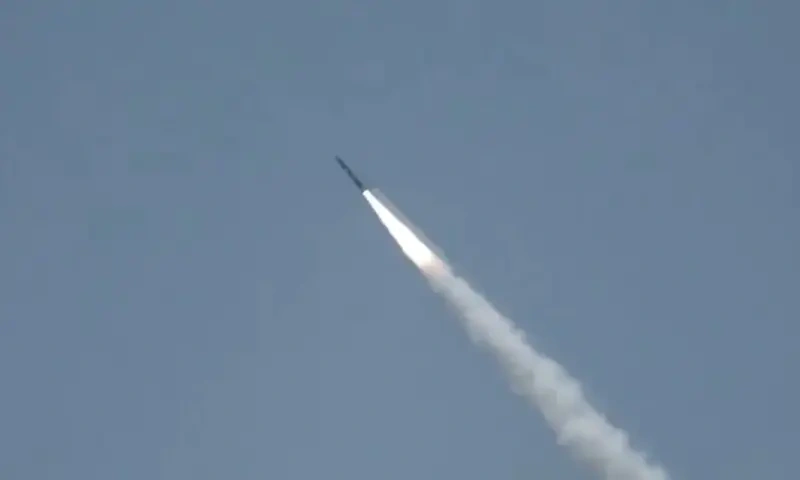
Rawalpindi: Pakistan Army has successfully carried out a training launch of the locally developed Fatah II missile system. The test marks another step in strengthening the country’s defense capability and technological progress.
According to the Inter Services Public Relations, the exercise was conducted by the Army Rocket Force Command on Tuesday. The main purpose was to test training readiness, system performance, and technical accuracy under operational conditions.
Today, Army Rocket Force Command conducted a successful training launch of indigenously developed Fateh-II Missile System, equipped with advanced avionics and state of the art navigational aids.
— PTV News (@PTVNewsOfficial) April 28, 2026
The training launch was aimed at training of troops, validating various technical… pic.twitter.com/ptiIRrw4Gs
A step forward in local defense technology and precision capability
The Fatah II missile system is designed with modern navigation and advanced electronic systems. These features allow it to hit targets with high accuracy and improved reliability.
In addition, the training launch was used to evaluate different technical components of the system. This included checking performance under real operational conditions and improving overall precision.
As a result, military experts believe the system adds strength to Pakistan’s growing indigenous defense technology base. It also reflects continued efforts to reduce dependence on external systems.
Meanwhile, the successful test follows a series of recent developments in Pakistan’s missile program. Earlier systems such as Fatah IV and the Timor cruise missile have also been tested successfully, showing steady progress in defense capabilities.
Leadership praise and growing focus on military self-reliance
The successful test was observed by senior military officials, scientists, and engineers involved in strategic programs. They reviewed the performance and technical outcomes of the system during the exercise.
Following the test, President Asif Ali Zardari, Prime Minister Shehbaz Sharif, Chief of Defence Forces and Chief of Army Staff Field Marshal Asim Munir, along with other service chiefs, praised the team involved.
They appreciated the technical skill, dedication, and professional effort behind the achievement. In their view, such progress reflects strong coordination between military institutions and local scientists.
Furthermore, officials highlighted that Pakistan continues to focus on strengthening its defense through local innovation and research. This approach is seen as important for long term strategic stability.
In conclusion, the successful Fatah II training launch is being viewed as another milestone in Pakistan’s defense development journey. It reinforces the country’s emphasis on precision capability, self-reliance, and regional balance.











