
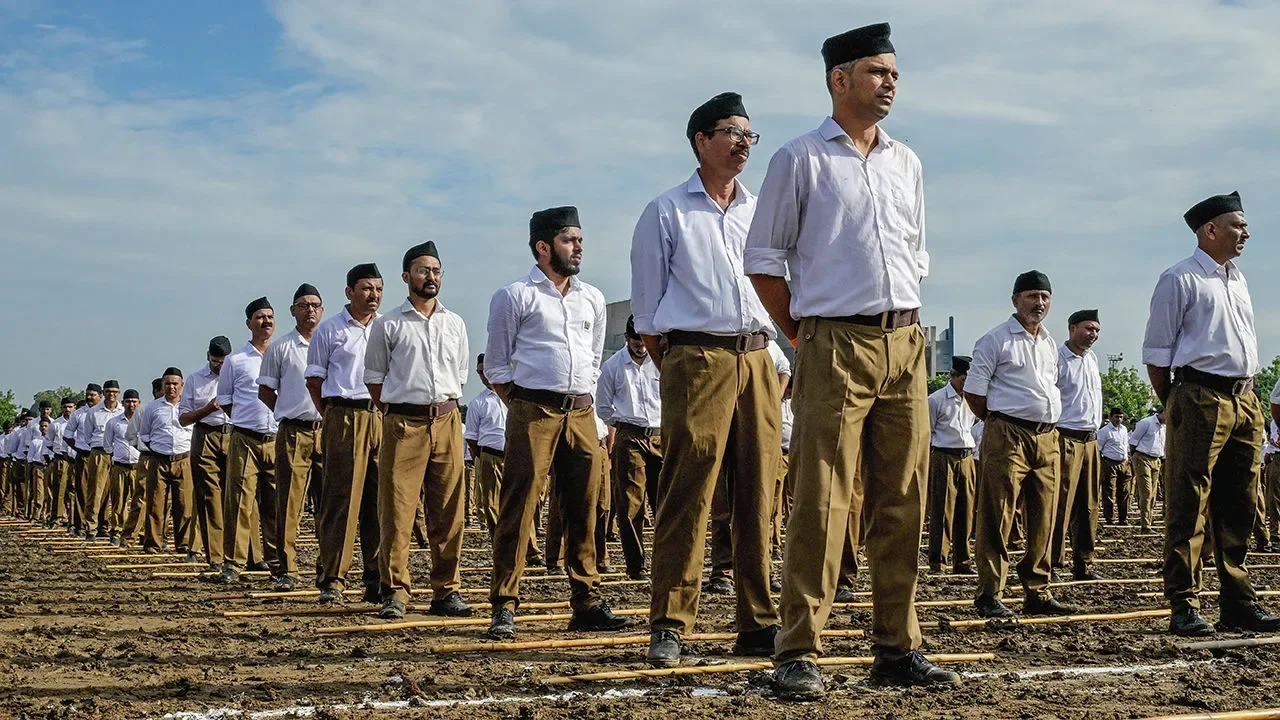
New York – A newspaper article published by The New York Times (NYT) has shed light on the 100th anniversary of the Rashtriya Swayamsevak Sangh (RSS) and how the group has risen to prominence in Indian politics.
This analysis depicts the RSS as an extremist, secretive, paramilitary group with a secretive agenda.
The report says that a hundred-year plan of the group was a calculated Hindu supremacy plan that was meant to turn India into a secular democracy, but into a nationalist state, with minorities being marginalized.
Ideological Roots and Training
The American newspaper dates the group to 1925, and the training camps of the group have been the long-term meeting points to organize religious hatred.
According to the report, the founders of the organization were guided by racist ideas typical of mid-20th-century Europe.
The Hindu supremacy plan is founded on the notion that India is the home of Hindus, frequently locating enemies within the Muslim community and other minorities within the country.
The report serves as a reminder to the readers that the RSS was prohibited in 1948 when Mahatma Gandhi was assassinated by a former member because he was considered Muslim-friendly.
India’s paramilitary RSS — driven by a hatred for religious minorities and a love of majoritarian supremacy — makes the NYT front page.
— Audrey Truschke (@AudreyTruschke) December 29, 2025
And it should. A group this powerful ought to have its history, ideology, and actions heavily scrutinized. #Hindutva https://t.co/gGLmr21Eid pic.twitter.com/smpa4JBUik
The Political Face: BJP and Policy
One of the themes of the analysis by the Times is that the ruling Bharatiya Janata Party (BJP) is not only a political outfit, but also the political arm of the RSS.
According to the report, under the present government, this Hindu supremacy plan has entered the corridors of power.
The main policy decisions, including the 2019 abolition of the special autonomous status of Kashmir, can be seen as direct manifestations of the group’s long-standing ideological ambitions.
The newspaper indicates that the destruction of the ancient Babri Masjid was a symbolic and literal failure of the secular constitution of India.
Impact on Minorities
The report presents a gloomy outlook on the humanitarian status of the minorities in India and says that they have become second-class citizens.
The NYT concludes that the Hindu supremacy plan remains the driving force behind the future of the world’s most populous country and poses important questions about the viability of pluralism and secularism in the region in the long term, as the organization approaches its 100th year of existence.











