
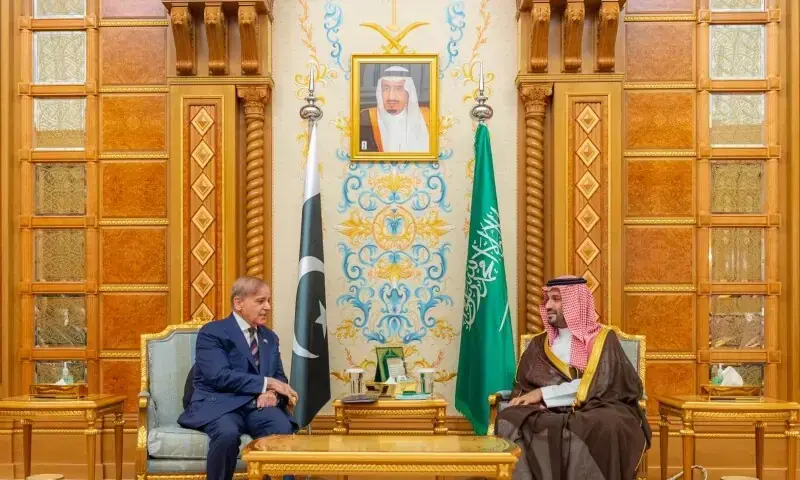
Riyadh / Islamabad – In a significant development reflecting the depth of their longstanding alliance, Pakistan and Saudi Arabia have announced the launch of a comprehensive Economic Cooperation Framework to strengthen bilateral trade, investment, and development collaboration across multiple sectors.
The decision was jointly announced following a meeting between Crown Prince Mohammed bin Salman, Prime Minister of Saudi Arabia, and Prime Minister Muhammad Shehbaz Sharif in Riyadh on October 27, 2025, on the sidelines of the Future Investment Initiative (FII9) summit.
According to the joint statement issued by the Ministries of Foreign Affairs of both countries, the framework builds upon nearly eight decades of close fraternal relations rooted in Islamic solidarity, mutual trust, and strategic partnership.
🔊PR No.3️⃣2️⃣1️⃣/2️⃣0️⃣2️⃣5️⃣
— Ministry of Foreign Affairs – Pakistan (@ForeignOfficePk) October 28, 2025
Joint Statement by the Kingdom of Saudi Arabia and the Islamic Republic of Pakistan https://t.co/HTFfIhdoOe
🔗⬇️ pic.twitter.com/kq0AghvlgT
Shared Vision for Economic Integration
The new framework aims to strengthen cooperation in key economic and developmental fields while expanding the role of the private sector and increasing trade exchange between the two nations.
Priority sectors identified under the framework include energy, industry, mining, information technology, tourism, agriculture, and food security. Both sides are also studying the signing of a Memorandum of Understanding for cooperation in the energy field, signaling new opportunities in sustainable development and industrial modernization.
The framework reaffirms both nations’ shared vision to build a sustainable partnership that aligns with Saudi Vision 2030 and Pakistan’s economic revival strategy, enhancing mutual prosperity and regional stability.
Strategic and High-Impact Projects
Officials said the framework will include a range of strategic and high-impact projects across trade, investment, and development fields. These projects aim to deepen bilateral coordination, promote joint ventures, and facilitate private sector partnerships that support long-term growth. Both leaders expressed confidence that the initiative would not only enhance government-to-government ties but also stimulate business-to-business collaboration.
Strengthening Fraternal Relations
The joint statement highlighted that this framework represents an extension of both countries’ efforts to reinforce their historic brotherhood and strengthen ties in a way that fulfills the aspirations of their leadership and people.
It noted that both sides share a commitment to translating their close political and defense cooperation into sustainable economic collaboration, reflecting a modernized and future-focused relationship. The leaders also agreed to convene the next session of the Saudi–Pakistan Coordination Council, the Supreme, which serves as the highest-level platform for steering strategic cooperation between the two countries.
Economic and Regional Significance
The launch of the framework follows several recent milestones, including the signing of a defense pact in Riyadh in September and the finalization of $6 billion in Saudi financial support, comprising $1 billion in oil facilities and $5 billion in deposit rollovers to aid Pakistan’s economy.
It was a great pleasure and honor to meet my brother, His Royal Highness Crown Prince Mohammed bin Salman, in Riyadh today.
— Shehbaz Sharif (@CMShehbaz) October 27, 2025
We reaffirmed the enduring strength of the Pakistan–Saudi Arabia brotherly bonds and discussed ways to further expand this historic and time-tested… pic.twitter.com/dYdqylsalw
For Islamabad, this agreement represents a shift toward investment-driven economic diplomacy, while for Riyadh, it reinforces Saudi Arabia’s role as a regional economic hub and development partner under Vision 2030.
With over 2.5 million Pakistani expatriates living in the Kingdom, the largest source of remittances for Pakistan’s $407 billion economy, the framework is expected to expand opportunities for workforce development, business cooperation, and sustainable growth.











