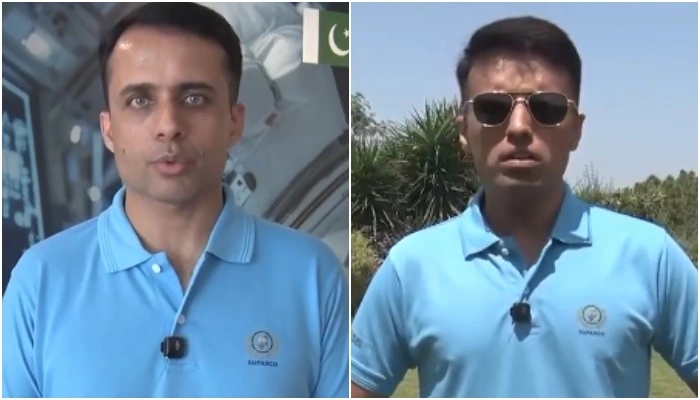
Pakistan has marked a major milestone in its space journey as the national space agency SPARCO announced the selection of two astronauts for a Chinese space mission. The selected candidates, Khurram Dawood and Muhammad Zeeshan Ali, have been sent to China for advanced training.
This development places Pakistan among a small group of countries involved in human spaceflight programs. According to SPARCO, the astronauts will prepare for participation in China’s space missions under the Shenzhou program. One of them is expected to serve as a payload expert aboard the China Space Station during a mission planned for the end of 2026.
Transitioning from selection to training, officials say the astronauts will undergo detailed preparation to handle complex space tasks. This includes learning how to work in microgravity conditions and operate advanced scientific systems used in orbit.
Scientific Research in Microgravity to Benefit Multiple Fields
Once in space, the Pakistani astronaut will conduct experiments in a zero gravity environment. These studies will focus on areas such as material science, fluid physics, life sciences, and biotechnology. Experts believe these experiments could help address real world challenges on Earth.
In addition, researchers say the findings may support progress in climate change studies, food security, and industrial innovation. These are areas where space based research can offer unique insights that are not possible on Earth.
Meanwhile, Prime Minister Shehbaz Sharif praised the achievement and described it as a symbol of strong Pakistan China friendship. He said the selection reflects growing cooperation in science and technology between the two countries.
Looking ahead, scientific analysts view this mission as a turning point for Pakistan’s space program. They believe it could open new opportunities for research, training, and international collaboration.
In conclusion, this step is more than just a space mission. It represents Pakistan’s entry into a new era of scientific ambition, where the country moves closer to the frontiers of space exploration.