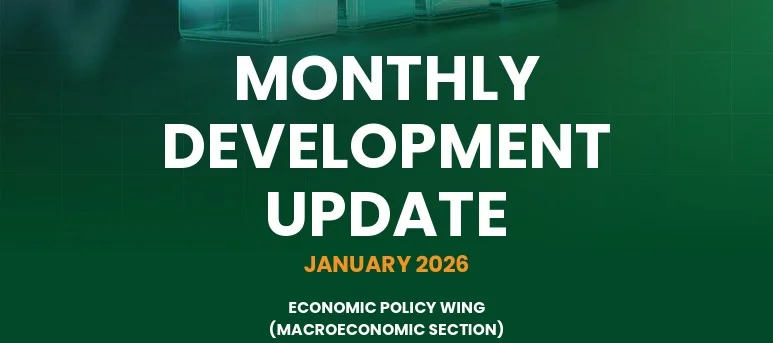
Pakistan’s latest Monthly Development Update for January 2026 published by ministry of planning development & special initiatives presents a picture that has been missing from the country’s economic story for several years: a sense of order returning to policy, numbers moving in the right direction and the state slowly shifting from crisis management to structured economic steering.
This is not yet a story of rapid growth or economic take-off but it is clearly a story of stabilization taking hold and confidence beginning to return.
The report shows an economy that has absorbed recent shocks, including flood-related disruptions and is now showing early but meaningful signs of recovery across growth, inflation, industry and public finances.
Growth and inflation show the return of economic balance
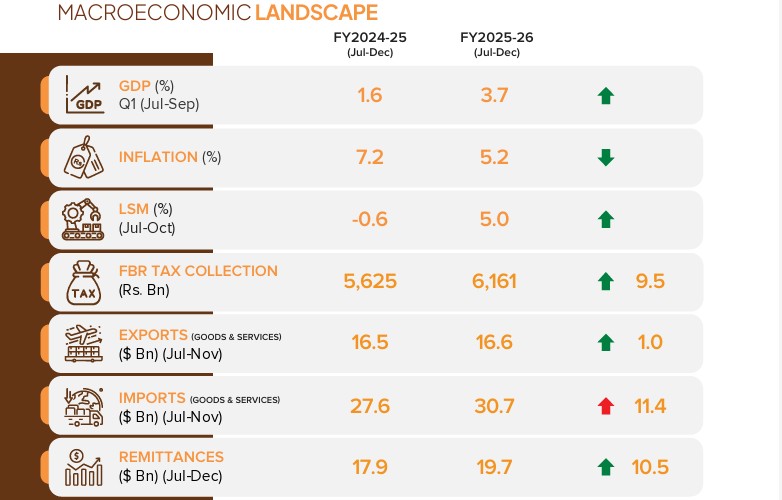
One of the strongest signals in the report is the improvement in core economic indicators. GDP growth in the first quarter of FY2025–26 reached 3.7 percent, more than double the pace recorded in the same period last year.
This recovery is not limited to one sector. Industry has led the rebound with particularly strong performance while agriculture and services have also contributed to overall growth.
At the same time, inflation has eased to an average of 5.2 percent in the first half of the fiscal year compared to over 7 percent last year.
The cooling of food prices and better supply conditions have played a key role in this. The combination of rising growth and falling inflation suggests that economic policy is finally restoring a basic macroeconomic balance that had been missing for years.
Large-scale manufacturing has also returned to positive territory, growing around 5 percent overall and accelerating to more than 8 percent in October driven by sectors such as cement, automobiles and petroleum products.

Confidence returns to markets and state finances
Beyond headline growth numbers, confidence indicators are also improving. The stock market crossed 174,000 points by the end of December 2025 reflecting rising investor optimism.
At the same time, tax collection by the FBR reached more than Rs 6.1 trillion in the first half of the fiscal year showing healthier state revenues and better enforcement.
These trends point to a gradual rebuilding of trust in the economic direction of the country. Businesses appear more willing to invest, and the state is in a stronger position to manage its finances than it was a year ago.
This does not mean that all risks have disappeared but it does mean that the economy is no longer operating in emergency mode.
External sector stability rests heavily on remittances
On the external front, stability has been maintained largely because of strong remittance inflows, which reached nearly $19.7 billion in six months, an increase of more than 10 percent.
Exports have managed to post modest growth despite flood damage to key crops and exchange rate stability has helped keep pressures under control.
However, the same figures also reveal a quieter set of concerns. Imports have risen sharply and the current account has slipped back into deficit.
Even more important is the continued weakness in foreign direct investment, which shows that global private investors are still cautious about Pakistan’s long-term prospects.
Development Spending and Infrastructure Show the State is Back in Motion
The development side of the report shows a government that is once again trying to plan and build at scale.
More than Rs 314 billion worth of projects were sanctioned in the first half of the year, with Rs 210 billion already spent. Infrastructure dominates the development strategy, particularly in transport, energy and water.
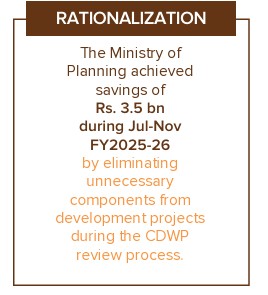
There is also a strong emphasis on discipline. The Ministry of Planning claims savings of Rs 3.5 billion through cost rationalization by cutting non-essential components from projects.
This reflects an attempt to move away from politically driven spending toward a more serious, results-oriented development approach.
Major projects in Gilgit-Baltistan, Gwadar, dams, highways and railway corridors show that the state is trying to reassert itself through connectivity, energy security and water management.
Jobs social sectors and the long road to real transformation
The report estimates that recently approved and recommended projects could generate around 3,000 direct and over 64,000 indirect jobs.
Education, health, family planning and polio eradication remain part of the development agenda, while initiatives like the Tea Commercialization Strategy aim to reduce import dependence and build agricultural value chains.
Still, social sector spending remains smaller than infrastructure and job creation is largely project-based rather than economy-wide. This underlines the core challenge ahead.
The January 2026 update shows that Pakistan has regained control of economic management and restored basic stability. The direction is now clearly positive.
The real test, however, is whether this stability can be converted into sustained growth, broad-based jobs and a truly competitive economy. Stabilization has been achieved. Transformation is the next and much harder step.
Read more: Islamabad Airport Becomes Pakistan’s First Fully Cashless Smart Airport