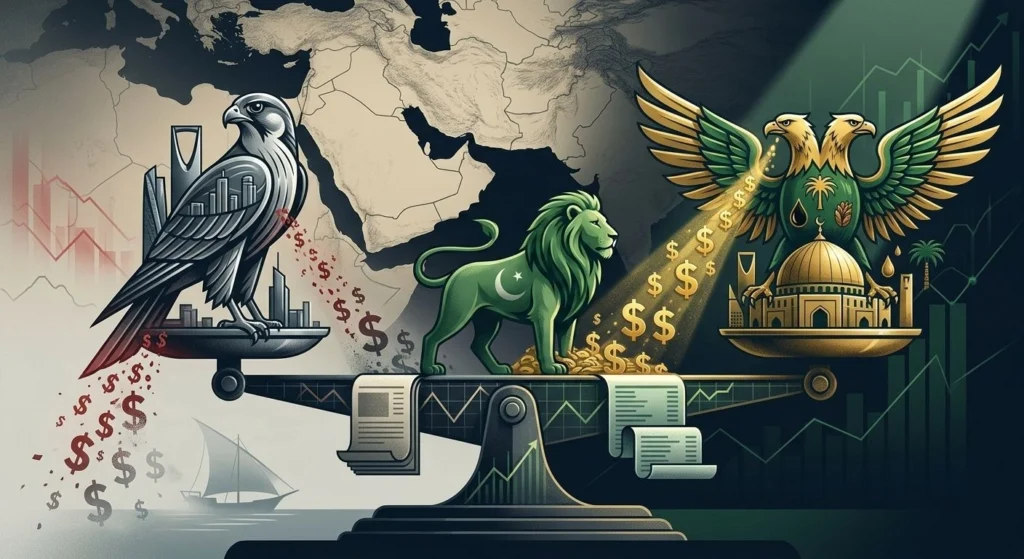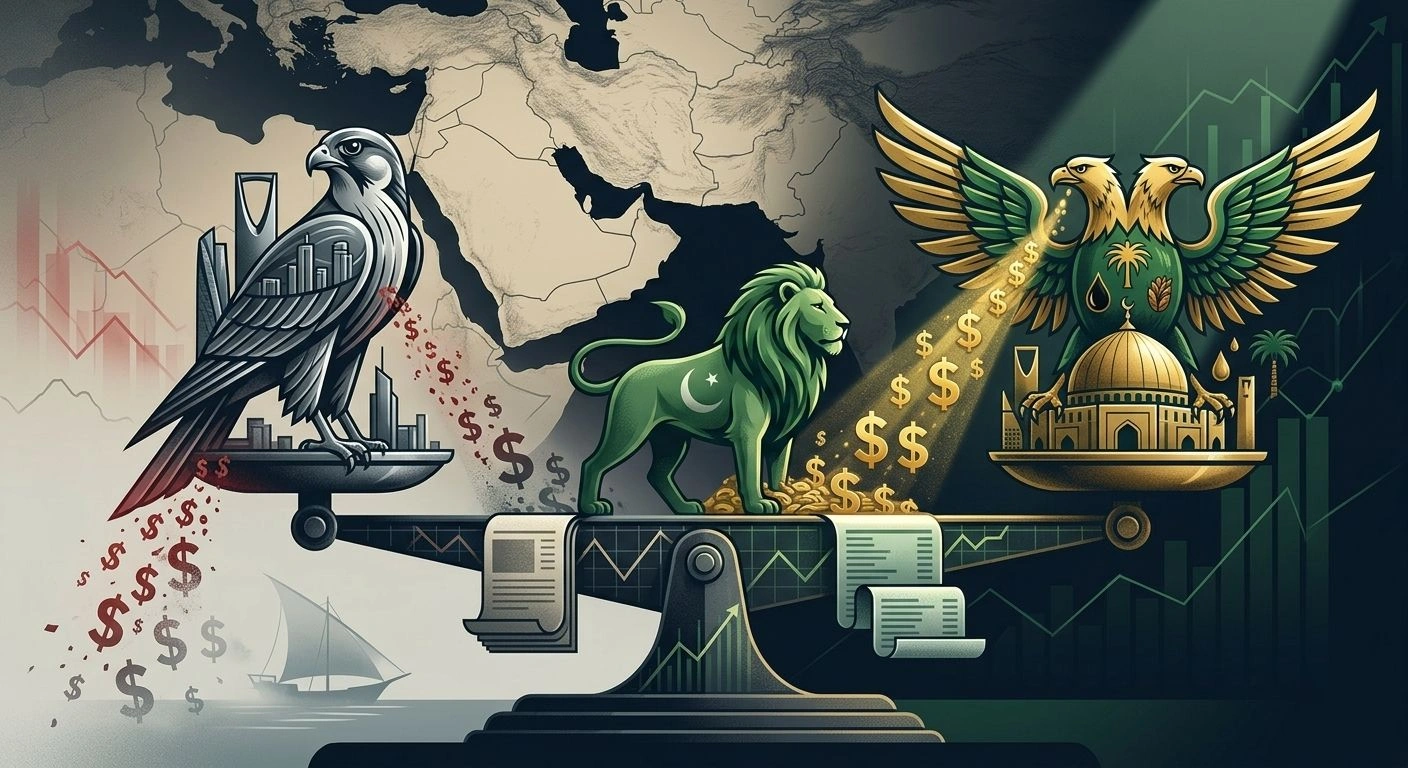
April 2026 proved to be an extraordinary month in Pakistan’s financial landscape. It was a month in which two contrasting decisions on a single State Bank balance sheet not only reflected economic realities but also appeared to signal a shift in diplomatic alignments. The United Arab Emirates fully withdrew its $3.45 billion deposit, which had remained with Pakistan for seven years, while Saudi Arabia simultaneously provided a fresh $3 billion deposit and extended its existing $5 billion facility until 2028. On the surface, these were routine financial transactions, but in essence they appeared to represent two different “votes” by Gulf powers on Pakistan’s policy direction.
This was not the first time Gulf countries have used financial leverage in the region, but the distinction this time was that deposits themselves were seemingly used as political signals. In the past, such deposits were generally treated as balance of payments support, neutral capital rolled over annually without being linked directly to foreign policy positions. Countries like Egypt, Jordan, Bahrain, Sri Lanka, and Pakistan have long relied on such inflows as stabilising reserves. However, in April 2026 this established understanding appeared to shift.
According to a Financial Times report, the UAE’s position was unusually explicit. Amid a regional war-like situation involving Iran and missile and drone attacks, questions were reportedly raised over Pakistan’s perceived neutral diplomatic stance. Abu Dhabi first limited its annual rollover to monthly terms and then abruptly decided on a complete withdrawal. This move came at a time when Pakistan’s mediation efforts on a proposed Hormuz framework were under international consideration as a potential diplomatic initiative.
Saudi Arabia, on the other hand, responded in the opposite direction. Within just seven days, Riyadh filled the financial gap by injecting fresh funds, signaling not only economic confidence but also endorsement of Pakistan’s neutral diplomatic approach. The Saudi Pakistan Strategic Defence Agreement of September 2025 had already added a structured framework to bilateral ties, further strengthened by growing military and diplomatic alignment.
Together, these developments point toward a deeper shift that has not yet been formally acknowledged. Gulf deposits are increasingly being viewed not just as financial instruments but as political referendums. In other words, financial decisions are now reflecting implicit views on a country’s foreign policy direction.
If this trend continues, its implications may extend beyond Pakistan. Countries such as Egypt, Jordan, Sri Lanka, and Lebanon, which also depend on Gulf deposits for their foreign reserves, could see similar conditions attached to future financial support. Every rollover, extension, or withdrawal may increasingly carry a diplomatic message, gradually reshaping the language of international economic relations.
For Pakistan, this moment represents a dual reality. On one hand, it faced financial pressure due to the withdrawal. On the other hand, it received continued and enhanced support that signals confidence in its diplomatic stance. In this sense, Pakistan effectively “paid twice” in April once through financial adjustment and again through validation of its policy position.
The balance sheet may have remained stable, but the system around it appears to be changing. The real question is no longer how large the deposits are, but what political signals they now carry.