
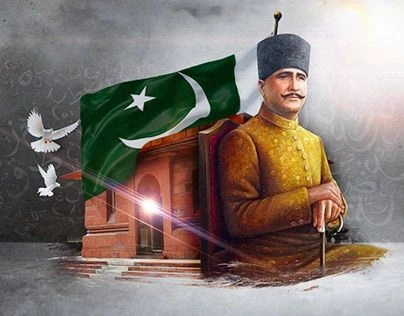
In an era where storms of intellectual confusion are dismantling old structures and global political balances are shifting, Pakistan’s emergence as a “center of stability” is not a coincidence but seen by many as the realization of a dream envisioned by Allama Muhammad Iqbal. As the nation marks the death anniversary of the Poet of the East, it becomes not merely a commemorative occasion but a moment of national reflection on whether Pakistan reflects Iqbal’s ideals of the “Mard-e-Momin” and “Bunyan al-Marsoos.”
History suggests that when falsehood rises against truth, destiny assigns certain regions the role of upholding justice. The May 2025 confrontation, remembered as “Operation Bunyan al-Marsoos,” is portrayed as more than a military response—it is described as an assertion of the self-respect and selfhood that Iqbal emphasized in his philosophy of “Khudi.” When neighboring India allegedly challenged Pakistan’s sovereignty, the response of the “Shaheens” demonstrated resilience that reportedly shocked observers, as India’s advanced defense systems failed to deliver expected results.
This episode, according to supporters of this narrative, sent a message beyond the region that Pakistan is no longer bound by defensive restraint but stands as a fortified state determined to protect its borders, with its adversaries miscalculating its strength.
In contemporary geopolitics, Pakistan is increasingly portrayed as a peace-oriented power, reflecting Iqbal’s vision of justice, integrity, and courage. During the recent US–Iran tensions, when the world was perceived to be on the brink of conflict, Pakistan is credited with playing a mediating diplomatic role that brought opposing sides to the negotiating table in Islamabad, helping de-escalate tensions.
International media attention on Pakistan’s role in facilitating dialogue is presented as recognition of its emerging image as a “peace envoy.” Similarly, increased reliance on Pakistani airspace and airports by international airlines is viewed as an indicator of its perceived stability in a turbulent global environment.
Economically, developments around Gwadar and shifting maritime routes due to tensions in the Strait of Hormuz are described as strengthening Pakistan’s strategic importance in global trade. Gwadar is portrayed as evolving from a vision into a key hub of international commerce, reinforcing Pakistan’s regional economic role.
On the diplomatic front, Pakistan’s engagement with Muslim countries is presented as strengthening the concept of a unified Ummah, elevating its position as a key regional partner. Growing trust from both regional and global powers is interpreted as evidence of Pakistan’s transition from isolation to a stabilizing force.
The narrative concludes by linking these developments to Iqbal’s poetic vision, suggesting that Pakistan is entering a transformative phase where its role as a symbol of peace, strength, and unity is becoming increasingly visible, though the journey toward its full potential is still ongoing.











