
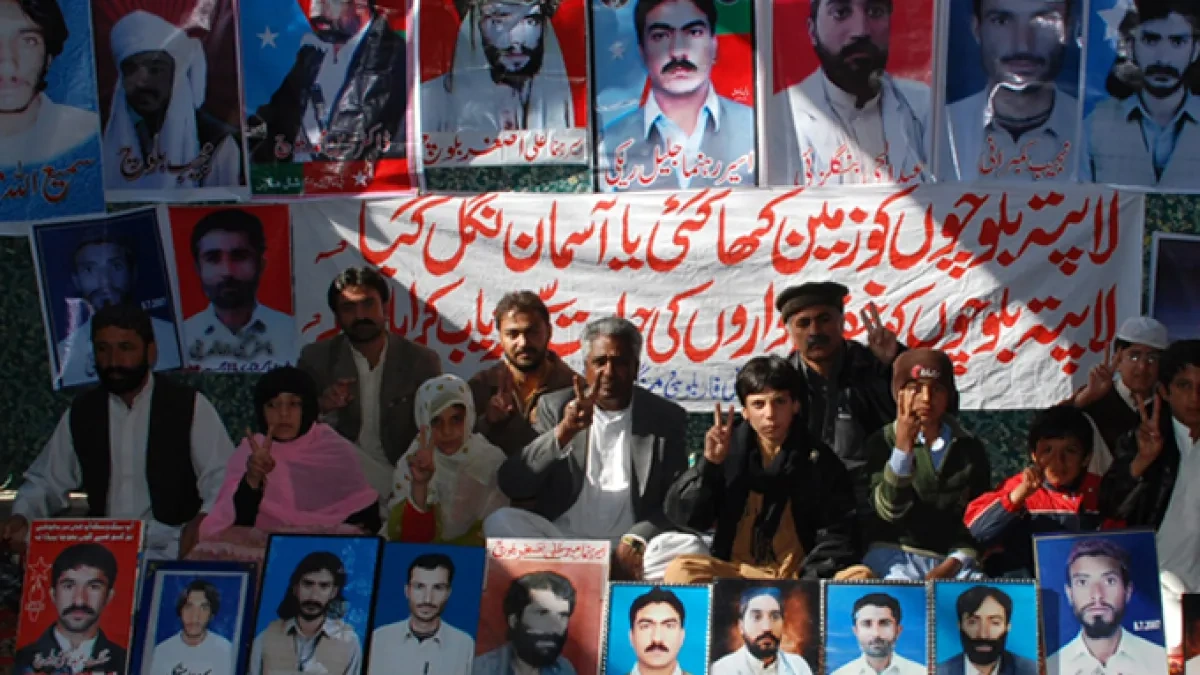
Under a deliberate and organized campaign against Pakistan, the issue of enforced disappearances is being used at the international level to defame the country and undermine national security. Certain elements linked to banned organizations and anti-Pakistan lobbies based abroad are exploiting this issue for their malicious political objectives. A deeper analysis of the facts reveals that the narrative of missing persons is, in reality, a calculated strategy to justify terrorism and weaken the state. This is not a coincidence but part of a well-planned effort aimed at increasing global pressure on Pakistan’s state institutions and destabilizing the country’s peace. Through this propaganda, youth are incited against the state and misled into becoming fuel for subversive activities.
Using various international platforms and social media networks, this narrative is portrayed as if severe human rights violations are taking place in Pakistan. However, ground realities are quite the opposite. Pakistan’s law enforcement agencies and judiciary are treating this issue with utmost seriousness and have taken concrete steps in this regard. It is essential to expose the real faces behind this propaganda and their motives so that the world can understand the truth behind this false narrative against Pakistan.
Statistics on Missing Persons and State Transparency
Research conducted by a student from Quaid-e-Azam University in Quetta, based on government reports and data from the Commission of Inquiry, has brought forward a new perspective. The data shows how seriously and responsibly the state is dealing with this sensitive matter. At the public level, the impression is often given that the state is ignoring the issue, but official records completely reject this propaganda.
From March 2011 to August 2025, around 10,618 cases of missing persons were reported. Of these, more than 8,800 cases have been disposed of, and over 6,800 individuals have been traced. This indicates that state institutions are consistently working to resolve this complex issue and continue to address new cases every year.
To further ensure transparency, concrete measures were taken in 2026 to bring state detention centers under judicial oversight. This step demonstrates that the state has nothing to hide and believes in the rule of law. These figures clearly show that the issue of missing persons is being used as a political tool, whereas in reality, state institutions are making every possible effort to recover missing individuals and provide relief to their families.
The Dual Role of Terrorism and Missing Persons
It is deeply concerning that many individuals previously labeled as forcibly disappeared were, in fact, members of terrorist organizations who had joined such groups and were killed while carrying out activities against the state. A clear and tragic example is the case of Saleem Baloch, a resident of Turbat and a graduate of Punjab University. His disappearance sparked outrage on social media, with the state being blamed. However, in February 2026, the banned BLA itself confirmed that Saleem Baloch had been training in its camps since November 2023 and carried out a terrorist attack on January 31, in which 37 innocent civilians were killed. This incident exposed those who were fueling this propaganda.
Similarly, Saira Baloch accused the state of her brothers’ disappearance in a BBC documentary, but images later surfaced showing her with BLA leader Allah Nazar. Other cases have also emerged involving commanders and militants of banned organizations, such as Sohaib Lango from Kalat, Karim Jan from Gwadar, and Abdul Wadood Sikzai, who was killed in a naval base attack. All of these individuals were listed among so-called missing persons but were, in reality, engaged in armed activities against the state. This clearly shows that the missing persons narrative is being used to shield terrorists and challenge the authority of the state.
Financial Interests and the Network of Foreign Funding
So-called activists and individuals running anti-Pakistan campaigns from abroad are gaining financial and political benefits from this situation. A video statement by Noreen Bangulzai serves as clear evidence of how Naeema Zahri, based overseas, offered financial incentives to include her brothers’ names in the missing persons list. These elements conduct negative campaigns against Pakistan’s security from abroad and work under specific agendas to defame the state.
Their objective is to fabricate a narrative of victimhood for financial gain, which has no basis in reality. These individuals are living luxurious lives through foreign funding while ignoring the real issues of Balochistan and operating propaganda networks. The roots of this propaganda are interconnected at the international level, with fake social media accounts and coordinated campaigns aimed solely at isolating Pakistan and damaging its economic and internal stability.
The people of Balochistan gain nothing from these activities; rather, their problems are exacerbated. The public must now understand that these so-called human rights advocates are actually working on foreign agendas and exploiting the emotions of innocent youth for personal gain.
State’s Firm Resolve and Future Course of Action
The issue of missing persons is highly sensitive and emotional, requiring the state to proceed with caution and in accordance with legal requirements. However, using it as a shield for terrorism is unacceptable. The state of Pakistan remains committed to resolving this issue and upholding the rule of law at all costs.
State institutions empathize with families whose loved ones are genuinely missing, but they cannot allow the concealment of individuals involved in terrorism. All available evidence indicates that the campaign carried out in the name of missing persons is, in fact, an organized propaganda effort aimed at harming national security.
The people of Pakistan must remain aware of these conspiracies and stand with their country and institutions. The time has come to expose those who exploit the suffering of innocent people for political gain and personal interests.











