
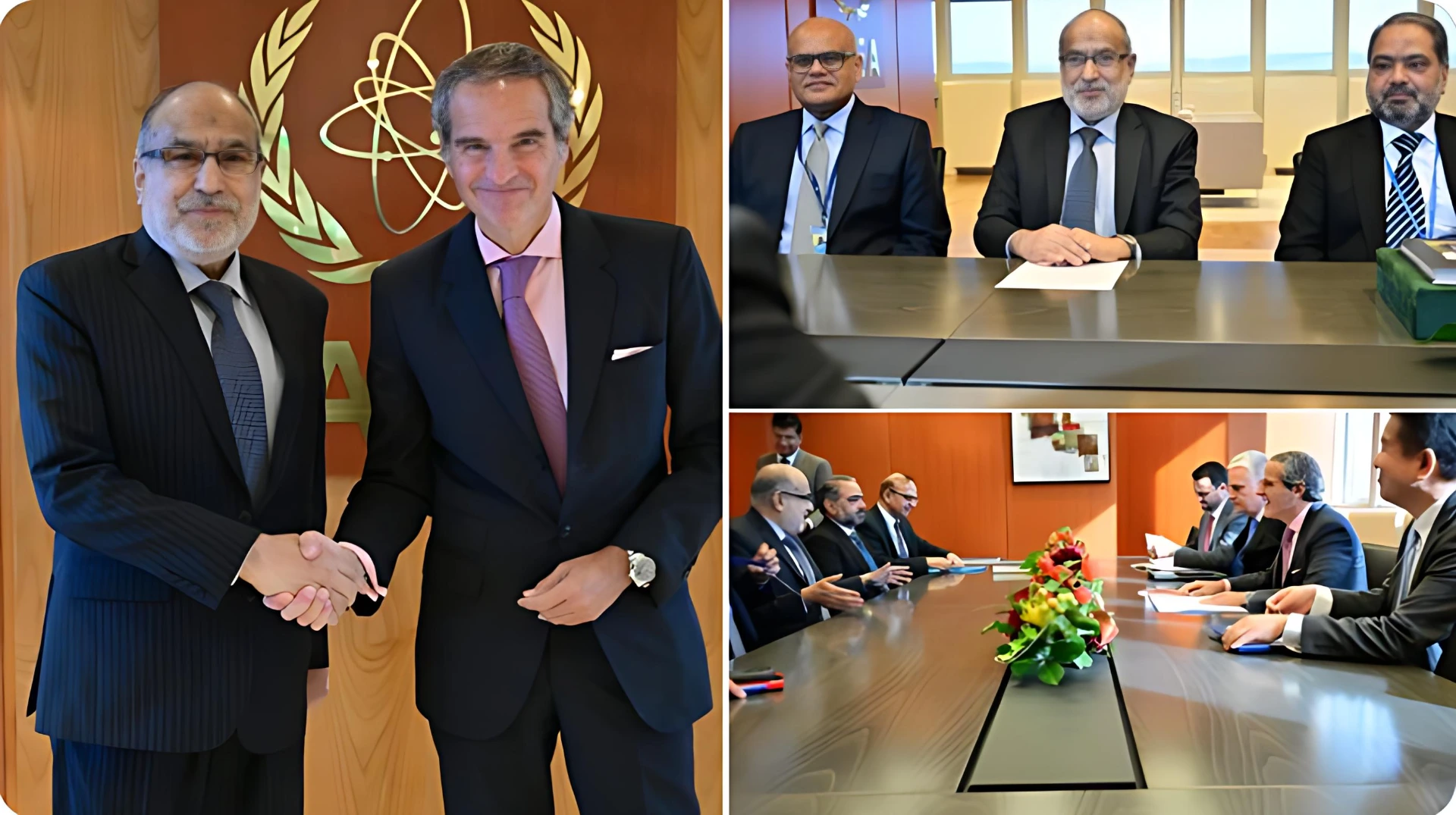
Islamabad/Vienna – Pakistan’s peaceful nuclear programme won praise this week from the head of the United Nations’ atomic watchdog, who highlighted Islamabad’s steady progress and close cooperation with the International Atomic Energy Agency (IAEA).
Pakistan is moving forward with its civil nuclear programme at a good pace, including at Chashma NPP 5, where I witnessed the first concrete pouring in Feb.
— Rafael Mariano Grossi (@rafaelmgrossi) September 19, 2025
At #IAEAGC, met PAEC Chairman Raza Anwar to review what’s been done and what’s ahead, including 🇵🇰’s exemplary… pic.twitter.com/pfEfnJnVyS
“Pakistan is moving forward with its civil nuclear programme at a good pace, including at Chashma NPP 5, where I witnessed the first concrete pouring in February,” IAEA Director General Rafael Mariano Grossi said in a post on X after meeting Raja Ali Raza Anwar, Chairman of the Pakistan Atomic Energy Commission (PAEC), on the sidelines of the 69th IAEA General Conference in Vienna.
Grossi recalled the landmark February 2025 pouring of first concrete for Chashma Nuclear Power Plant Unit-5, describing it as a major step in Pakistan’s efforts to strengthen energy security through clean, sustainable nuclear power. He also highlighted Islamabad’s active role in capacity-building, training, and the application of nuclear knowledge for socio-economic development, according to The Nation.
IAEA Cooperation and Regional Weight
The discussions also reviewed joint work under IAEA initiatives such as Atoms4Food, which focuses on boosting agricultural productivity and food safety, and Rays of Hope, aimed at expanding access to nuclear medicine and cancer care across Asia-Pacific. Grossi acknowledged Pakistan’s expertise in nuclear applications and its contribution to regional cooperation, stressing its role as a knowledge-sharing partner with other member states.
Reaffirming Islamabad’s position, Anwar said Pakistan’s nuclear power plants operate under the “highest safety standards” while providing reliable, low-carbon electricity. He underlined that PAEC programmes remain aligned with IAEA’s mission of promoting nuclear technology “for peace, health, and prosperity.”
Regional and Global Context
The IAEA chief’s remarks carry added weight in the regional context, coming just days after Islamabad signed a defence pact with Saudi Arabia and amid India’s growing unease over Pakistan’s strategic posture. Analysts said the acknowledgement validates Pakistan’s technical progress and strengthens its diplomatic standing as a responsible nuclear state committed to international norms.
Thank you for your encouragement & acknowledgment @rafaelmgrossi
— Dr. Asma Shakir Khawaja (@AsmaKhawaja5) September 22, 2025
Being DG @iaeaorg he endorsed
Pakistan's civil nuclear programme for its good pace. He termed Pakistan's progress in this regard "exemplary." #Pakistan #nuclearenergy #IAEA https://t.co/BNqj81BW5b
Experts further argue that the recognition feeds into Pakistan’s broader narrative, presenting it not only as a state safeguarding security but also as one leveraging nuclear technology for sustainable development. With global debates intensifying over climate change and energy security, they say Pakistan’s emphasis on nuclear energy, food security, and medical research positions it as a constructive partner on the world stage.











