
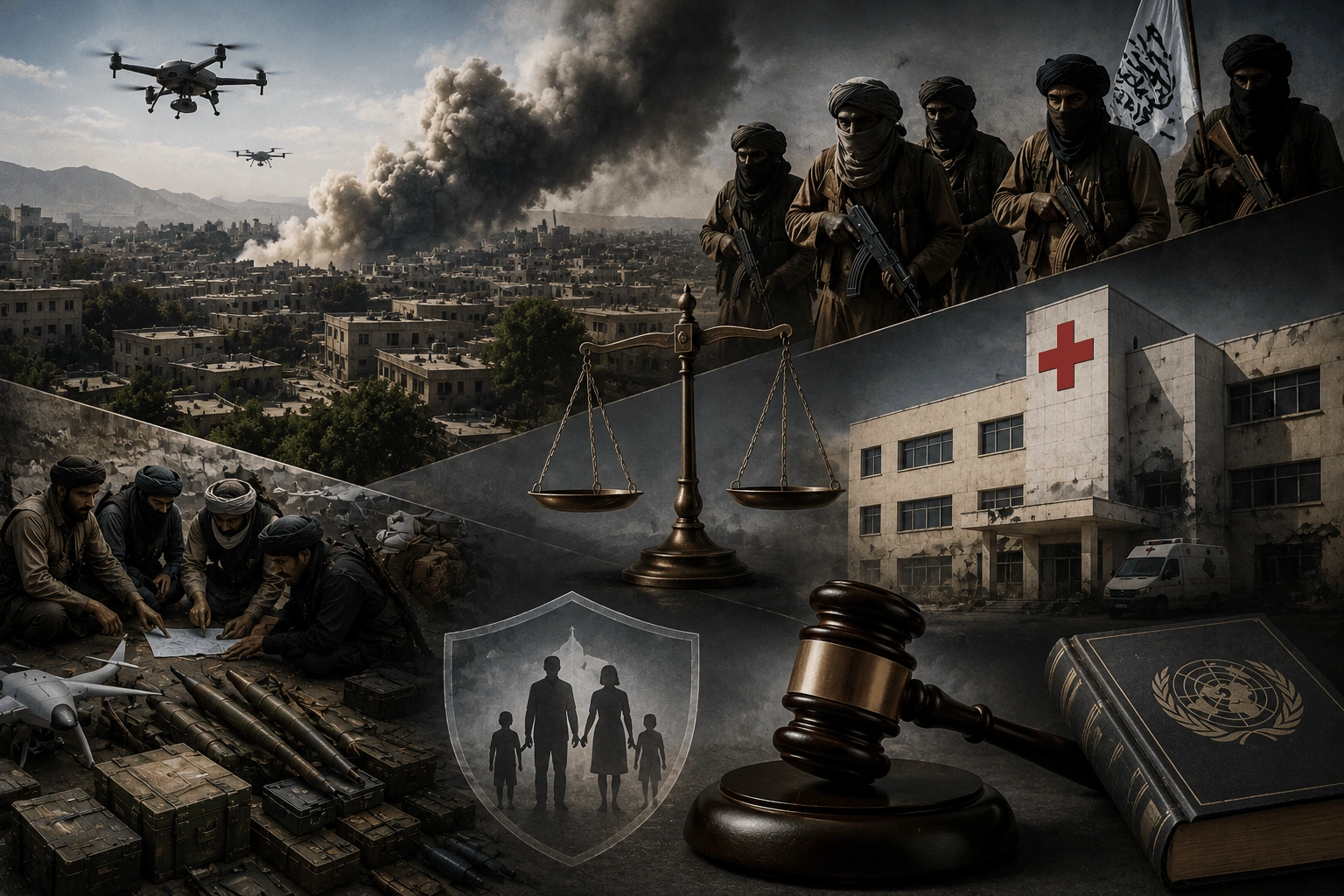
Taliban authorities have claimed that a site targeted in Kabul was a hospital, but conflicting reports and ground realities suggest a different picture. According to available evidence, the facility was allegedly being used for storing military-grade weapons and training militants, raising serious legal concerns under the Geneva Conventions and the Rome Statute. Under international law, any civilian site used for military purposes can lose its protected status.
Application of International Law
The allegations surrounding the site must be assessed under international humanitarian law rather than labels or claims alone. Under Article 8 of the Rome Statute, protection is granted only when a facility is not being used for military purposes. Once a location is utilized for storing drones, military equipment, or supporting militant operations, it may legally become a military objective under international law.
Reports indicate that the facility in question was allegedly being used for military logistics and operational support, leading to legal arguments that its protected civilian status no longer applied.
Concerns Over Use of Human Shields
Another major issue raised by analysts is the alleged use of the facility as a shield for surrounding military assets. International customary law and Article 51(7) of Additional Protocol I strictly prohibit the use of civilians or civilian structures to shield military objectives from attack.
Legal experts argue that deliberately embedding military infrastructure inside civilian-populated areas places civilians at direct risk and may constitute a violation of international humanitarian law. Such practices can shift legal responsibility onto those who militarize protected spaces.
Medical Facilities and Geneva Convention Requirements
Articles 18 and 19 of the Geneva Conventions state that medical facilities receive protection only when they are exclusively used for humanitarian and medical purposes, properly marked, and clearly separated from military objectives.
According to the reports, the facility known as “Omid” allegedly failed to meet the legal definition of a protected hospital. Claims of militant training activities and weapons storage at the site have been cited as evidence that the location no longer qualified for protected status under international law.
Violation of the Principle of Distinction
International humanitarian law is based on the principle of distinction, which requires a clear separation between civilian and military targets. Analysts claim that Taliban authorities blurred this distinction by integrating military operations within civilian infrastructure and populated areas.
Failure to separate military assets from civilian spaces is viewed as a breach of precautionary obligations, as parties in conflict are required to avoid positioning military objectives near civilians whenever possible.
Pakistan’s Legal Position
Pakistan maintains that its operational policy is based on the internationally recognized principles of distinction, proportionality, and precaution. According to this position, actions are directed only against locations identified as hostile military infrastructure, and the legality of a target is determined by its operational function at the time of engagement rather than by its label or public description.
Observers argue that converting civilian facilities into military sites and later using the consequences for propaganda reflects broader governance failures and exposes civilians to unnecessary danger.
Read more :Taliban Accused of Violating International Law Through Militarization of Civilian Infrastructure











