
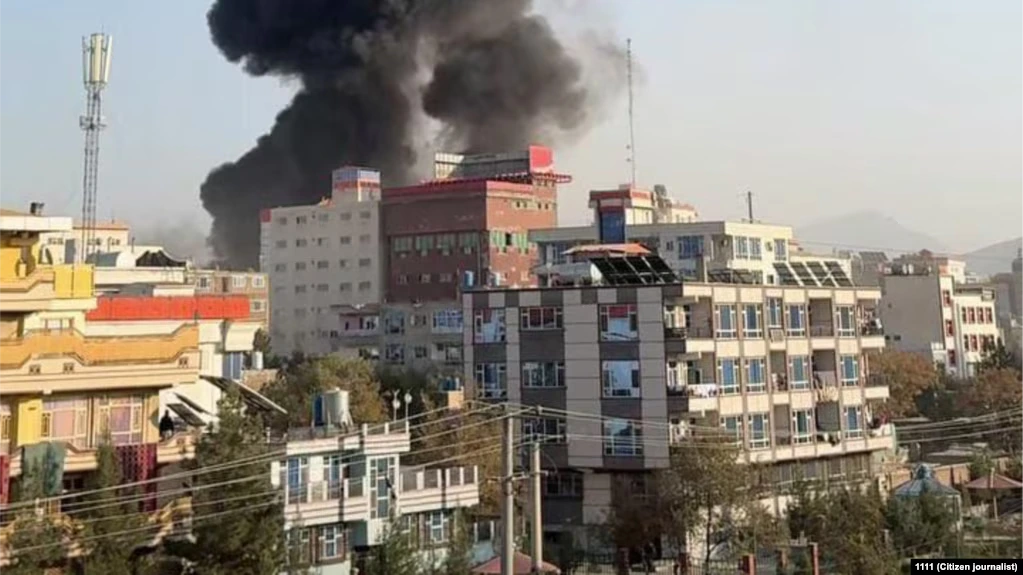
Islamabad – Following recent border clashes in Spin Boldak, the Taliban regime’s spokesperson, Zabiullah Mujahid, accused Pakistan of “unprovoked firing” that allegedly caused over 100 civilian casualties. However, Afghan media outlets and eyewitnesses have reported contradictory details that challenge his claims.
بدقسمتی سے آج صبح ایک بار پھر پاکستانی فورسز نے قندھار کے اسپین بولدک ضلع میں افغانستان پر ہلکے اور بھاری ہتھیاروں سے حملے شروع کیے، جس کے نتیجے میں 12 سے زائد عام شہری شہید اور 100 سے زیادہ زخمی ہو گئے۔
— Zabihullah (..ذبـــــیح الله م ) (@Zabehulah_M33) October 15, 2025
اس کے بعد افغان فورسز کو جوابی کارروائی پر مجبور ہونا پڑا۔
According to multiple Afghan sources, the confrontation began around 3 a.m. when Taliban forces opened fire near the symbolic Friendship Gate, ironically damaging their own side of the structure while the Pakistani side remained intact. Visuals circulating online show the Afghan gate destroyed, contradicting Mujahid’s assertion that Pakistan initiated the aggression.
Officials in Islamabad dismissed Mujahid’s allegations as “a distortion of facts,” asserting that Pakistan’s response came only after cross-border attacks launched by militants operating under Taliban protection. “This is a textbook diversion,” one official stated. “Pakistan acted solely in defense of its sovereignty and civilians.”
Security analysts say Mujahid’s statement is part of a broader disinformation campaign aimed at deflecting internal pressure within Afghanistan, where the regime faces economic turmoil, growing public discontent, and rising insurgent infighting.
Contrary to Taliban claims of “civilian casualties,” Pakistani officials confirmed that only militant firing positions, actively engaging security posts, were targeted, not civilian areas. Islamabad maintains that it has repeatedly shared coordinates of over 60 confirmed TTP and BLA camps operating across Afghan provinces including Kunar, Paktika, and Khost, but Kabul has consistently failed to act.
Breaking!!
— HTN World (@htnworld) October 15, 2025
Pakistan conducts precision strikes on Afghan Taliban’s Battalion No. 4 and Border Brigade No. 6 in Kandahar, destroying both. The strikes mark Islamabad’s latest retaliation after repeated provocations by the Taliban regime along the border. pic.twitter.com/0LvPiis99e
Adding to the misinformation, Mujahid posted a video claiming Taliban forces had captured a Pakistani tank. Defence experts quickly debunked the footage, identifying the vehicle as a T-62 tank, never part of Pakistan Army’s inventory, which uses T-59 and T-69 variants in its western sectors. The T-62, however, is known to be used by Taliban units.
“Such propaganda exposes the regime’s duplicity, calling for diplomacy while glorifying clashes against a neighboring Muslim country,” a senior Pakistani security source said.
This is a T-62 tank which has never been in the inventory of Pakistan Army. They operate T-59 and T-69 tanks in KP and Balochistan. Infact the Taliban have T-55/T-62 tanks. https://t.co/0XNvDX4Rvp
— Fidato (@tequieremos) October 15, 2025
Pakistan has shown restraint for months despite repeated provocations and cross-border attacks that have claimed civilian and military lives. Officials reiterated that Islamabad remains committed to peaceful coexistence but reserves the right to respond proportionately to any violation of its borders.
Analysts emphasize that stability in the region can only emerge if Kabul dismantles terrorist sanctuaries and stops its soil from being used against Pakistan. As one Islamabad-based observer noted, “Propaganda cannot disguise the truth, Afghanistan must end its patronage of militants if it truly seeks peace.”











