
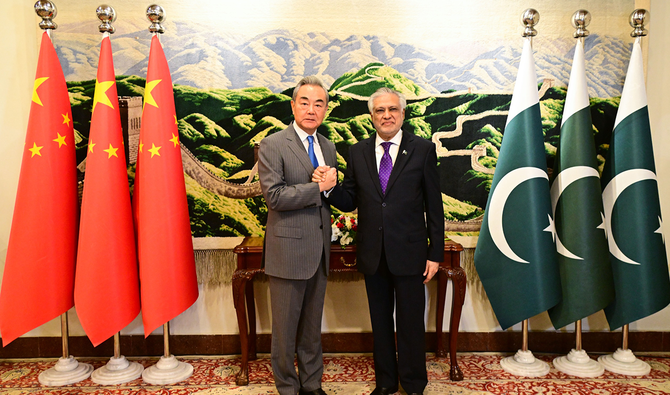
Islamabad: Chinese Foreign Minister Wang Yi began strategic talks with his Pakistani counterpart, Deputy Prime Minister and Foreign Minister Ishaq Dar, in Islamabad on Thursday. The meeting marks the sixth round of the Pakistan-China Foreign Ministers’ Strategic Dialogue, an institutionalized platform for advancing bilateral and regional cooperation.
Wang arrived in Islamabad on Wednesday, days after concluding high-profile engagements in New Delhi with Indian leaders, including Foreign Minister Subrahmanyam Jaishankar, National Security Adviser Ajit Doval, and Prime Minister Narendra Modi. His Pakistan trip underscores Beijing’s balancing role in South Asia, where tensions remain high between India and Pakistan.
Dialogue after border and military tensions
The visit comes just months after a brief but intense military standoff between India and Pakistan in May. During the confrontation, Islamabad deployed Chinese-made fighter jets and missile systems. While Indian officials alleged Beijing actively backed Pakistan, Islamabad maintained that its success relied on its own capabilities.
This backdrop highlights the importance of Wang’s visit. The dialogue aims to address not only bilateral matters but also evolving regional security concerns. Both sides are expected to reaffirm support for each other’s core issues, coordinate on multilateral platforms, and discuss strategies to counter regional instability.
Expanding economic cooperation under CPEC
Pakistan views China as its most reliable economic and diplomatic partner. Beijing has invested heavily in Pakistan’s infrastructure, energy, and telecom sectors through the China-Pakistan Economic Corridor (CPEC), a flagship project of China’s Belt and Road Initiative.
The ongoing dialogue is expected to focus on accelerating CPEC projects, boosting trade, and enhancing cooperation in emerging sectors such as digital connectivity. Pakistan’s foreign office described Wang’s visit as part of a series of regular high-level exchanges designed to reaffirm trust and expand collaboration.
A symbol of regional balance
The Pakistan-China Foreign Ministers’ Strategic Dialogue has provided a steady mechanism for bilateral consultations since its launch in 2017. This sixth round comes at a time when shifting alliances and disputes continue to shape South Asia’s political landscape.
By engaging with both India and Pakistan in the same week, China signals its intent to maintain influence and stability in the region. For Islamabad, the talks reaffirm a long-standing partnership that remains central to its foreign and economic policy.











