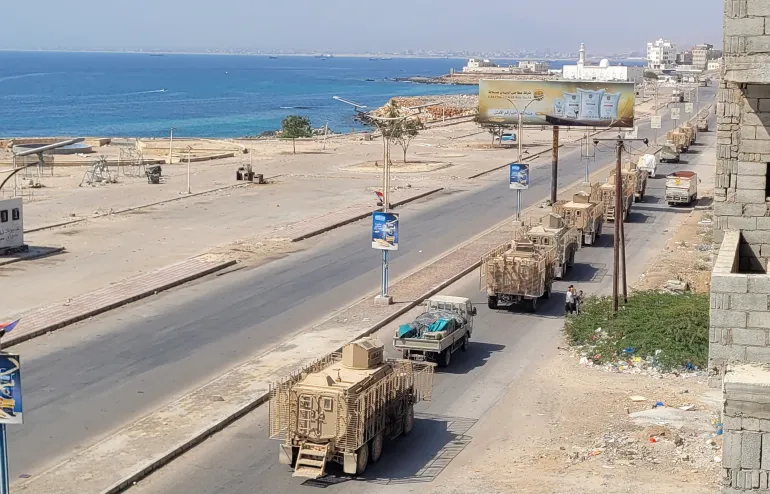
Fighting has reignited in eastern Yemen, especially in Hadramout, after Saudi-backed government forces moved to reclaim bases from the UAE-backed Southern Transitional Council.
The clashes followed the STC’s recent territorial advances and its declaration of a two-year path toward secession.
Yemen now stands at a dangerous crossroads, where internal fragmentation and proxy rivalries risk turning a long war into a permanent regional fault line.
Fighting has erupted in Yemen’s Hadhramaut province near the Saudi border between forces loyal to the Saudi-backed governor and the UAE-backed Southern Transitional Council (STC). pic.twitter.com/Tv5AVGGEZt
— HTN World (@htnworld) January 2, 2026
Hadramout emerges as a critical frontline
Hadramout borders Saudi Arabia and carries major strategic weight. Forces loyal to the Saudi-backed governor say they are acting to “peacefully and systematically” restore state control.
The STC has accused Saudi Arabia of bombing its positions near the border. Local authorities reject that claim and say militias cannot control sensitive provinces.
Riyadh has made clear that armed groups near its borders pose a direct national security threat.
Update!!
— HTN World (@htnworld) January 2, 2026
Tensions escalated in Yemen’s Hadhramaut after STC leader Aidarus al-Zubaidi announced a two-year transitional phase toward southern independence, saying it was intended to restore “the southern state” and reflected “the will of southern Yemenis.”
As Saudi-backed forces… pic.twitter.com/mCBtpAF6Hk
Yemen split into competing zones of control
Yemen is no longer defined by a single frontline.
The Houthis dominate the north. The STC holds sway across large parts of the south. The internationally recognized government controls pockets in the center and east with Saudi support.
Small AQAP remnants linger in remote areas. This fragmentation has turned the conflict into overlapping proxy struggles rather than a unified civil war.
Exclusive: Yemeni Deputy Foreign Minister Mustapha Noman explains how the Saudi-led coalition supported government efforts to restore stability and order in eastern Yemen.#SaudiArabia #Yemen @MustaphaNoman pic.twitter.com/nehqaO75fk
— Al Arabiya English (@AlArabiya_Eng) January 2, 2026
Saudi Arabia pushes state authority and border security
Saudi Arabia continues to back Yemen’s recognized government and rejects parallel armies or unilateral power grabs.
Riyadh views sudden territorial seizures in Hadramout and al-Mahra as destabilizing. Officials stress that unity and legitimacy must guide any security arrangement.
Coalition strikes near Mukalla signaled that arms flows to militias cross a red line.
🇸🇦🇦🇪 UAE proxies on the run
— 5Pillars (@5Pillarsuk) January 2, 2026
Footage and reports released today show Emirati-backed militias in full retreat in Yemen and parts of Sudan as forces backed by Saudi Arabia make major gains.
In south Yemen, UAE-backed separatists have been forced out of key positions in Hadramout… pic.twitter.com/xMfhRENts6
UAE withdrawal and the risk of parallel agendas
The United Arab Emirates has confirmed that its last forces have left Yemen and called for de-escalation. Abu Dhabi frames its role as counterterrorism-focused. Questions remain over continued support for the STC.
Diverging approaches between partners have added strain, but both sides stress dialogue. Analysts warn that competing agendas only deepen fragmentation.
The United Arab Emirates has confirmed its last troops have left Yemen and called for de-escalation in the wake of air strikes by the Saudi-led coalition against the separatist Southern Transitional Council (STC).
— Al Jazeera English (@AJEnglish) January 2, 2026
🟠 LIVE updates: https://t.co/X957XbNNEI pic.twitter.com/qxkzsq2v04
Regional stakes extend beyond Yemen
Control over ports and coastlines affects global trade. Bab-el-Mandeb, together with the Strait of Hormuz, forms a vital security arc.
Any militarized push along Yemen’s coast risks shipping lanes and humanitarian access.
Islamabad-based analysts say Pakistan supports Saudi leadership in stabilizing Yemen while valuing ties with both Riyadh and Abu Dhabi. They urge restraint and a UN-led political process.
Furthermore, officials in Islamabad support Saudi Arabia’s leadership in stabilizing Yemen and strengthening the internationally recognized government, especially as Yemen fragments into competing zones of control dominated by the Houthis in the north and the STC across parts of the south.
Similarly, Pakistan values its strategic relations with both Saudi Arabia and the UAE, acknowledging their past roles in counterterrorism and humanitarian support, and believes differences should be resolved quietly and constructively, not through escalation.
Moreover, Yemen’s conflict should not become a theater for competing agendas among partners; Saudi coordination remains central to preventing further fragmentation, protecting navigation routes, and avoiding vacuums that extremist networks can exploit.
ابناء مدينة #سيئون بمحافظة حضرموت يعبرون عن سعادتهم بعد هروب مليشيات الانتقالي من المدينة#عمليه_استلام_المعسكرات #اليمن #قناة_اليمن pic.twitter.com/EGtj4SfesM
— قناة اليمن الفضائية | YemenTv (@yementvyem) January 2, 2026
Yemen’s stabilization now depends on unified command under the recognized government, not rival forces.
Dialogue must replace force. Political solutions protect borders, trade routes, and civilians across the region.
Read more: UAE Confirms Final Withdrawal of Troops from Yemen