
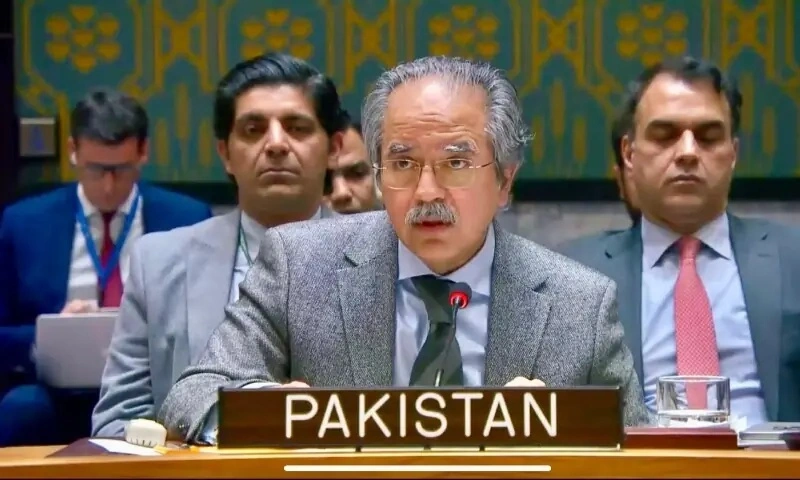
Islamabad, February 2026 – As highlighted by Asim Iftikhar Ahmed in his post on X, Pakistan emphasized the growing threat of terrorism emanating from Afghanistan during a briefing at the United Nations Security Council on “Threats to International Peace and Security Caused by Terrorist Acts.” The country called for coordinated international action against externally sponsored terrorist groups and stressed the need for accountability for actors destabilizing the region.
Pakistan’s Sacrifices in Global Counterterrorism
Pakistan highlighted its status as a frontline state in the global fight against terrorism, noting more than 90,000 casualties and substantial economic losses over the years. Officials stressed that Pakistan’s sacrifices underscore its commitment to regional and international peace and security.
Resurgence of Terrorist Groups in Afghanistan
Since the Taliban takeover in Kabul, proxy terrorist groups such as Fitna al-Khawarij TTP and Fitna al-Hindustan BLA and its Majeed Brigade have received renewed support and funding from foreign sponsors, according to Pakistan’s statement.
Pakistan urged the UN Security Council to designate BLA under the 1267 sanctions regime, supporting the ongoing listing request to curb these groups’ influence.
Global Terror Threats on the Rise
The briefing highlighted that the threat posed by Da’esh has grown increasingly complex, particularly in West and Central Africa, the Sahel, and South Asia. Pakistan called for a collective and coordinated response, emphasizing the Global Counter Terrorism Strategy (GCTS) as a framework for addressing these evolving challenges.
Terrorism in Afghanistan and External Support
Pakistan pointed out that the Afghan de facto authorities (DFA) provide a permissive environment for terrorist groups, especially TTP, and stressed that external actors financing, arming, and supporting these groups must be held accountable.
State Terrorism and Kashmir
The statement condemned acts of state terrorism in areas such as Indian Illegally Occupied Jammu and Kashmir (IIOJK). Pakistan stressed that occupation and repression cannot be disguised as counterterrorism and called for the protection of peoples’ right to self-determination.
Addressing Global Counterterrorism Gaps
Pakistan underscored the need to adapt UN counterterrorism architecture and sanctions regimes to tackle contemporary threats fairly and comprehensively. Officials noted that current counterterrorism policies disproportionately target Muslims, while new forms of terrorism must also be addressed.
Unity and Cooperation as the Key
Terrorism, Pakistan emphasized, can only be defeated through unity, cooperation, and prevention of politically motivated exploitation, without double standards or discrimination.
The country also highlighted the upcoming 9th GCTS review as an opportunity to strengthen global counterterrorism efforts.
Pakistan’s Commitment to Multilateral Action
Finally, Pakistan reaffirmed its support for multilateral initiatives to develop holistic strategies to combat and eradicate terrorism, calling on the international community to close existing gaps and take practical steps to ensure global security.











