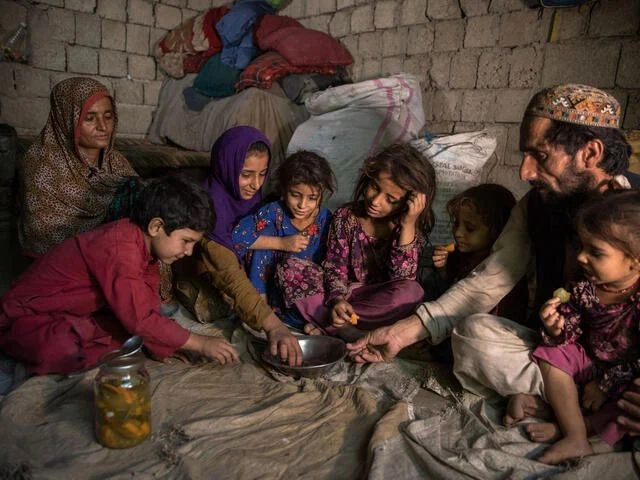
Afghanistan is facing one of its most serious waves of inflation, yet instead of addressing the root economic causes, the Taliban administration has turned to direct market control. This includes deploying inspectors from the Ministry for the Promotion of Virtue and Prevention of Vice, shutting down several markets, arresting traders, and imposing official price lists on food items, housing, and essential goods.
At first glance, this approach may appear to protect consumers, but in practice it targets the symptoms rather than the causes of the crisis—an economy driven by limited supply, rising demand, import dependency, structural fragility, and repeated external shocks.
Prices cannot be reduced through administrative orders. In a market suffering from shortages, currency constraints, import dependence, monopolistic control, and disrupted supply chains, price lists do not correct the imbalance; instead, they push the market toward black markets, corruption, and further shortages.
A Crisis Beyond Internal Mismanagement
The inflation crisis in Afghanistan is not purely domestic. It is deeply connected to regional trade disruptions, tensions between Afghanistan and Pakistan, instability in Iran, forced migration, and Afghanistan’s heavy reliance on imports of essential goods. As a result, any border closure, migration shock, or regional crisis quickly translates into rising prices inside the country.
On the supply side, the closure of key border crossings between Afghanistan and Pakistan in October 2025 significantly reduced imports. Pakistan remains one of the main routes for food, fuel, medicine, and essential goods entering Afghanistan.
At the same time, the crisis in Iran and reported attacks involving the United States and Israel against Iran have further increased transport costs, disrupted energy supplies, and raised trade risks, putting additional pressure on Afghanistan’s second major import route. These disruptions have directly contributed to shortages and rising prices.
On the demand side, Afghanistan has faced unprecedented pressure. According to a United Nations report published on February 1, the return of more than five million migrants has increased the population by around 10 percent. Even with limited purchasing power, this population requires food, shelter, healthcare, water, energy, and basic services. Environmental crises such as earthquakes and floods have further intensified the pressure.
Therefore, rising prices are not simply the result of traders’ behavior, but a reflection of a fragile economic system simultaneously strained by supply shocks, demand pressure, migration, currency shortages, and trade dependency.
According to the World Food Programme report dated April 17, food prices in Afghanistan have increased by up to 47 percent. This indicates that the crisis is not temporary inflation but a deep structural pressure directly affecting household livelihoods and food security.
Market Control as a Security Response to an Economic Crisis
Instead of structural reform, the Taliban’s response has largely focused on direct market intervention. The Ministry for the Promotion of Virtue and Prevention of Vice has stated that its inspectors have closed markets and detained traders accused of overpricing. Authorities have also imposed fixed price lists for essential goods and even housing rents, warning of legal action against violators.
However, despite these measures, prices have not fallen. The reason is clear: market logic does not follow administrative commands. When supply is restricted, imports are disrupted, demand increases, and trade is controlled by limited networks, price lists cannot reduce inflation; they simply shift economic activity into informal and unregulated channels.
The first problem with price lists is that governments cannot accurately determine equilibrium prices. Prices are formed through the interaction of supply and demand. When supply falls and demand rises, prices increase. No administrative body can precisely calculate equilibrium prices in a market involving thousands of sellers, importers, intermediaries, and millions of consumers. In such conditions, price lists become assumptions rather than economic policy.
If the officially set price is below the market level, sellers reduce supply, shortages increase, and black markets emerge. If it is above market levels, consumers are harmed. In both cases, price lists distort market signals instead of stabilizing them.
The second problem is black markets and corruption. The Taliban cannot monitor thousands of vendors, importers, warehouses, and distribution networks across the country. As a result, goods are withheld, sold informally at higher prices, and enforcement pressure may even create opportunities for bribery and corruption.
From an economic theory perspective and global policy experience, price controls in such fragmented markets are widely considered ineffective and costly. Therefore, the Taliban’s price lists are seen more as a sign of weak economic management than a solution to inflation.
What Is the Solution?
There is no quick or simple solution to Afghanistan’s price crisis, but effective policy is possible.
In the short term, the priority must be increasing supply and reducing import costs: diversifying trade routes, easing restrictions on traders, facilitating imports of food, medicine, and fuel, lowering tariffs, and using alternative routes through Central Asia to reduce dependence on Iran and Pakistan.
In the medium term, combating monopolies must go beyond small shopkeepers and target major import and distribution networks. Small retailers are not the main drivers of prices for fuel, flour, oil, or medicine. Real control lies with large importers and supply chains.
At the same time, foreign currency shortages must be managed. With Afghanistan’s trade deficit estimated at nearly $10 billion, prioritizing foreign exchange for essential imports is critical. Food, medicine, and energy imports must take priority over non-essential goods within a transparent and regulated framework.
In the long term, price stability is impossible without reducing import dependency. As long as Afghanistan relies on external sources for food, medicine, fuel, and essential goods, any border closure, currency shock, or geopolitical crisis will trigger inflation.
Strengthening domestic production, agriculture, livestock, food industries, storage capacity, and strategic reserves is essential to reduce vulnerability.
Conclusion
Afghanistan’s inflation crisis is not a crisis of small traders—it is a structural economic crisis. It is driven by supply disruptions, rising demand, import dependency, currency shortages, monopolistic control, weak domestic production, and administrative limitations.
Unless policy shifts toward increasing supply, improving competition, stabilizing currency, and reducing import dependence, price controls will not stabilize the market. Instead, they will deepen shortages, expand corruption, and push economic activity further into informal and unstable channels, worsening the crisis rather than solving it.