
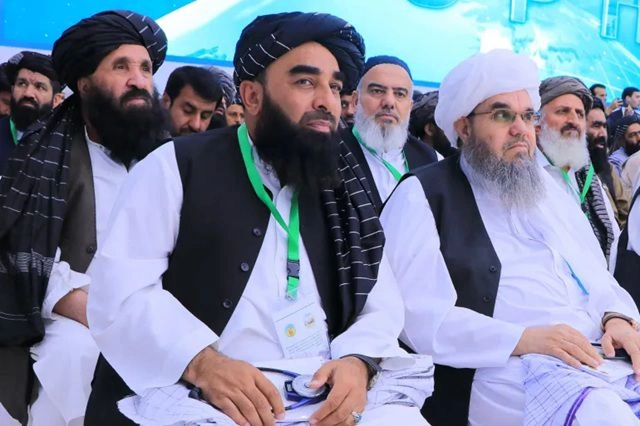
Over the past two decades, Afghanistan has cycled through war, foreign intervention, and fragile attempts at political transition. The Taliban’s return in August 2021—twenty years after their removal by U.S.-led forces—marked a decisive shift. Following a long insurgency against the U.S.-backed government in Kabul, they reasserted control, bringing a governing model that continues to raise international concern.
Since then, economic and social conditions have worsened. The economy remains weak, with widespread job losses, rising poverty, and deepening food insecurity. Basic services are limited, humanitarian needs are growing, and women and girls have been particularly affected—most girls over twelve are out of school, and many women are excluded from work, shrinking both opportunity and public participation.
At the same time, regional tensions have intensified. Afghanistan’s ties with Pakistan deteriorated in late 2025, leading to deadly border clashes. The situation improved with a short ceasefire but the peace collapsed during early 2026 when violence resumed which included attacks against Pakistani border forces. The internal political situation of Afghanistan shows how it affects the regional security issues that extend beyond its borders.
Since August 2021, Afghanistan has not evolved into a broadly recognized or participatory political system. Instead, power has consolidated in a highly centralized structure. At its center is Mullah Haibatullah Akhundzada, who claims authority as Amir al-Mu’minin. Yet this authority appears to rest less on public consent or institutional legitimacy and more on control established at the moment of takeover. The promises of a national jirga-once suggested as a mechanism for consultation—were never fulfilled. No meaningful public pledge of allegiance was sought, and even within Taliban ranks, there is little evidence of broad-based consensus-building.
Decision-making today appears concentrated in Kandahar, within a small and opaque circle of roughly twenty to twenty-five key figures. The governance system operates through personal control which restricts political participation to a specific circle of individuals. The system of authority operates from upper management positions through restricted access to information and limited chances for employee input.
The model operates in direct opposition to Islamic governance principles which require legitimacy to be established through shura, public acceptance, and accountability. Public endorsement established Abu Bakr al-Siddiq as the first leader of Muslims according to early historical precedent which confirmed that multiple leaders shared power. The classical scholars Ibn Taymiyyah and Yahya ibn Sharaf al-Nawawi and Ahmad ibn Hajar al-Asqalani established a distinction between legitimate authority and force-based rule which they regarded as usurpation. The current system in Afghanistan establishes major doubts about its supposed legitimate authority according to these standards.
The government has created an environment where people cannot freely express disagreement. Visible dissent is almost non-existent, and those who try to speak out face serious risks. International observers report that dissenting voices are treated as threats to authority rather than as part of normal political life. Authorities respond with intimidation, detention, and punishment against those seen as critical. In some areas, public executions and floggings have returned, creating an atmosphere where people remain silent to stay safe rather than share their views.
Religion plays a central role in this system, but its application has become increasingly restrictive. The legal system follows the Hanafi school and gives only limited recognition to other Islamic interpretations. Instead of accommodating religious differences, it often penalizes them. Observers have also noted inconsistencies in enforcement, where outcomes can vary based on social status, raising concerns about fairness and equal treatment under the law.
These pressures affect minority communities more severely. In Badakhshan, the Ismaili community faces growing daily challenges, as noted in multiple reports. In 2025, there were several accounts of people being pressured to adopt mainstream beliefs. Shia students in some educational institutions are also pushed to follow Hanafi doctrine or risk exclusion. Taken together, these patterns suggest a shift toward a more uniform religious system.
The governing structure reflects a similar ethnic imbalance. Afghanistan is a multi-ethnic society, yet leadership remains heavily concentrated in one group. The Rahbari Shura—estimated at around twenty to twenty-five members-is largely composed of Pashtuns. The cabinet includes only limited representation from other communities, with no Hazara members and no women. Key ministries such as Interior, Defence, Finance, and Justice are also led by figures from the same background, reinforcing this lack of diversity.
The Kandahar-centered governance system strengthens existing power concentrations. The official roles of non-Pashtun officials do not provide real decision-making authority, as power remains elsewhere. Security institutions, which employ hundreds of thousands of personnel, limit meaningful participation from Tajiks, Uzbeks, Hazaras, and Turkmen. In this context, representation appears largely symbolic, with little real impact.
Institutionally, Afghanistan operates with minimal transparency or oversight. There is no functioning parliament, limited judicial independence, and a highly restricted media environment. Decision-making takes place within a closed system, with little visibility into process or accountability. Afghanistan now ranks among the most constrained environments globally for press freedom, further limiting public scrutiny.
The system extends deeply into social life. More than one hundred decrees have been issued that impact women’s rights through educational and employment limitations. Women have been systematically excluded from public life which has created changes in their social and economic presence throughout society. The loss of intellectual and academic spaces has created a situation where people can no longer engage in essential discussions that support future growth.
The Taliban shows limited tolerance for differing views within its own ranks. The case of Abbas Stanakzai illustrates this dynamic. His relatively moderate positions on women’s education and internal consultation led to a loss of influence between 2023 and 2025. Reports indicate that he faced restrictions, including marginalization and possible threats of detention. He is now believed to be living outside Afghanistan, leaving him unable to participate in decision-making. His trajectory shows how difficult it is for individuals within the leadership to maintain independent viewpoints.
Minority communities, particularly the Hazaras, continue to face structural vulnerabilities. Their mosques, educational institutions, and communities have been targeted in repeated attacks, often with limited state protection. While some level of representation exists, it has not translated into meaningful influence or security.
Economic conditions further reflect the consequences of this governance model. A large proportion of the population faces poverty or economic vulnerability, with millions experiencing food insecurity. Access to education has declined sharply, particularly for girls, while economic opportunities remain limited. These trends reflect both external pressures and internal policy choices.
Supporters of the current system often describe the situation as one of stability. Yet this stability appears less the result of broad-based acceptance and more the product of constraint. When dissent is restricted and participation limited, the absence of visible conflict does not necessarily indicate legitimacy—it may instead reflect compliance.
The implications extend beyond Afghanistan. A governance model that combines centralized authority, restricted participation, and religious justification raises broader questions about legitimacy and statecraft. For regional and international actors, engagement becomes more complex when authority is neither clearly representative nor institutionally grounded.
At its core, governance has always been about more than control. In both political and Islamic traditions, authority is tied to responsibility-to consult, to remain accountable, and to ensure justice. When these elements are minimized, the nature of power itself begins to change. In Afghanistan today, the system that has emerged reflects a form of governance where silence is not agreement, but survival.
Note: This article is sourced from Sri Lanka Guardian.











