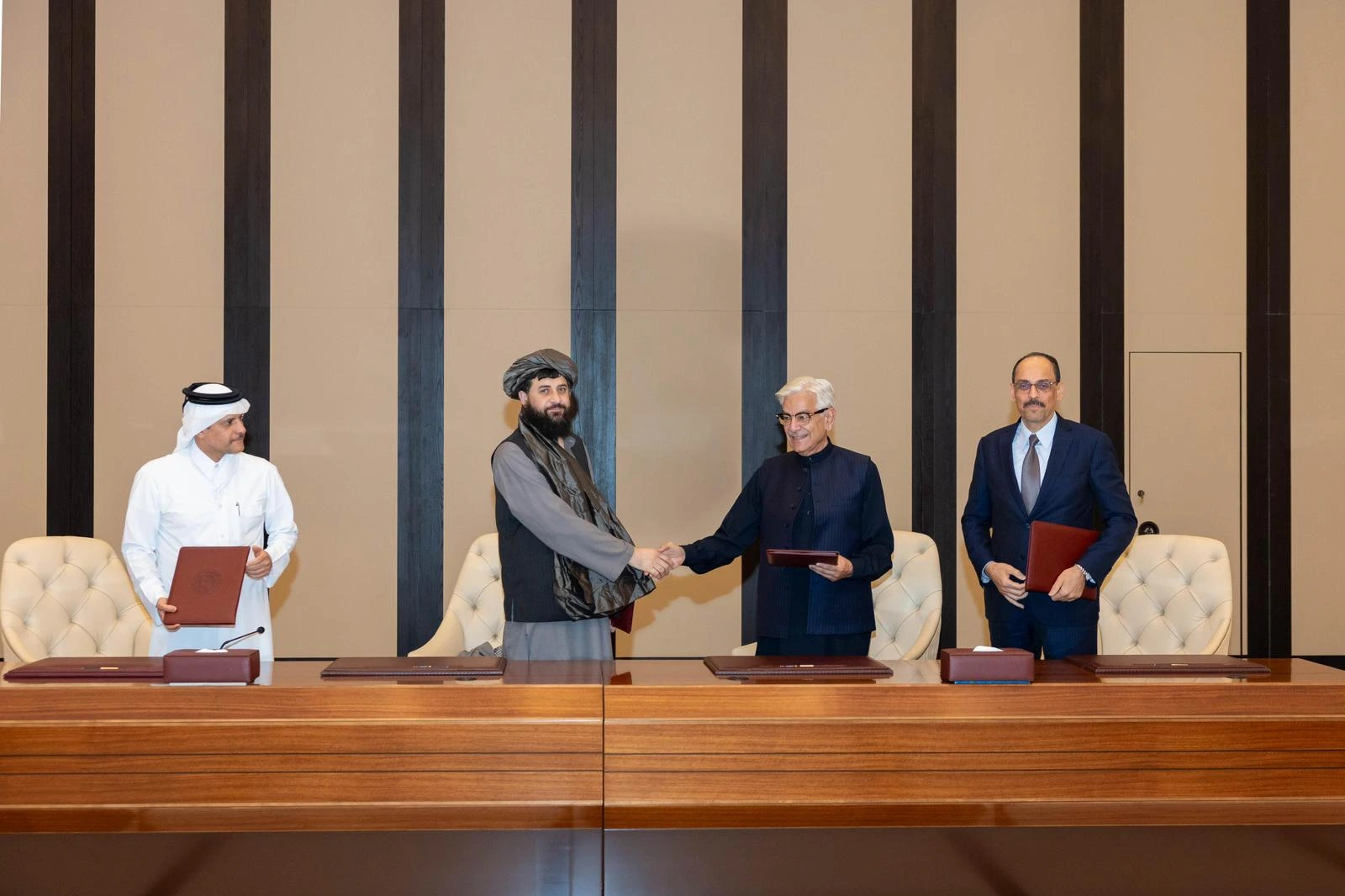
DOHA, Qatar: The first round of high-level talks between Pakistan and the Islamic Emirate of Afghanistan concluded in Doha after intense deliberations, with both sides agreeing to an immediate ceasefire under the mediation of Qatar and Türkiye.
According to diplomatic sources, both delegations presented their concerns, grievances, and security reservations during the session hosted by Qatar’s Ministry of Foreign Affairs. The meeting was overseen by Saud bin Abdul Rahman, Adviser to the Qatari Prime Minister and Defence Minister, and Abdullah bin Mohammed Al Khulaifi, Head of Qatar’s Ministry of Interior and Peace Affairs.
Sources revealed that the talks began in a tense atmosphere, with heated exchanges reported from both sides. However, Qatari officials helped ease tensions through personal assurances and active mediation.
Positions of Both Sides
Pakistan’s delegation asserted that the banned Tehreek-e-Taliban Pakistan (TTP) and Gul Bahadur Group were launching terror attacks inside Pakistan from sanctuaries across the Afghan border. Pakistani officials reportedly presented evidence, stating, “We have clear proof that militants cross into Pakistan from Afghanistan, and Pakistani citizens receive extortion calls from across the border.”
The Afghan delegation responded by claiming that the TTP and Gul Bahadur elements were, in fact, operating inside Pakistan. “Those Afghans who fight in Pakistan do so on their own. The Afghan Taliban do not sponsor them,” Afghan officials said.
Speaking to HTN Urdu, Afghan affairs expert Salman Javed said the ceasefire agreement between Pakistan and Afghanistan was a positive step. “Zabihullah Mujahid’s statement that Afghanistan will no longer support any terrorist group is proof that Pakistan’s evidence was strong and convincing,” he added.
Qatar’s Official Statement
Following the talks, Qatar’s Ministry of Foreign Affairs released a statement confirming that both Pakistan and Afghanistan had agreed to an immediate ceasefire and to establish a permanent mechanism for maintaining peace and stability.
The statement further said that both nations would hold a follow-up meeting in Istanbul in the coming days to ensure the implementation and continuation of the ceasefire. Qatar expressed hope that this breakthrough would help reduce border tensions and pave the way for long-term regional peace.
Key Discussion Points
According to diplomatic sources, Qatar proposed a long-term cooperation framework between Pakistan and Afghanistan, which includes joint counterterrorism measures, intelligence sharing, coordinated border management, and a structured plan for handling Afghan refugees.
Statement | Pakistan and Afghanistan Agree to an Immediate Ceasefire During a Round of Negotiations in Doha#MOFAQatar pic.twitter.com/fPXvn6GaU6
— Ministry of Foreign Affairs – Qatar (@MofaQatar_EN) October 18, 2025
Although both sides failed to reach a consensus on all points, Qatar confirmed that “dialogue will continue in the spirit of reconciliation.”
Defence Minister Khawaja Asif’s Statement
Pakistan’s Defence Minister Khawaja Muhammad Asif announced that a formal ceasefire had been reached between the two countries. “The cycle of cross-border terrorism will now end immediately. Both nations will respect each other’s territorial sovereignty,” he stated.
پاکستان اور افغانستان کے مابین سیز فائر کا معاہدہ طے پاگیا۔ پاکستان کی سرزمین پہ افغانستان سے دھشت گردی کا سلسلہ فی الفور بند ھوگا۔ دونوں ھمسایہ ملک ایک دوسرے کی سرزمین کا احترام کریں گے الحمدوللہ
— Khawaja M. Asif (@KhawajaMAsif) October 18, 2025
25اکتوبر کو استنبول میں دوبارہ وفود میں ملاقات ھو گی۔ اور تفصیلی معاملات بات ھوگی۔… pic.twitter.com/OKNbRuXEPU
He added that the next round of talks would take place in Istanbul on October 25, focusing on detailed implementation measures. Asif thanked Qatar and Türkiye for their vital diplomatic efforts, saying, “We are deeply grateful to our brotherly nations who brought both sides to the table.”
Response from the Afghan Government
Taliban spokesperson Zabihullah Mujahid confirmed that the talks were conducted “in a brotherly spirit” and resulted in “a comprehensive and meaningful ceasefire.”
He said both countries had agreed not to conduct any aggressive operations against each other or support groups that attack Pakistan. Mujahid further announced that a joint mechanism would be established to address future grievances and ensure the effective enforcement of the agreement.
Press Release
— Zabihullah (..ذبـــــیح الله م ) (@Zabehulah_M33) October 19, 2025
Negotiations between representatives of the Islamic Emirate of Afghanistan and the Islamic Republic of Pakistan, held in Qatar, have concluded with the signing of a bilateral agreement.
1/5
Expressing gratitude to Qatar and Türkiye, Mujahid said, “We appreciate the constructive role of our brotherly nations who helped guide both sides toward the path of peace.”
Analysis: First Step or Temporary Pause?
Analysts view the Doha ceasefire as a welcome but fragile breakthrough in Pakistan-Afghanistan relations. The sustainability of the truce will depend on follow-up meetings and concrete steps against cross-border militancy.
Despite the agreement, deep mistrust remains, particularly over Pakistan’s claims that Afghan soil continues to be used for terrorist attacks. The mediation efforts by Qatar and Türkiye have revived hope for dialogue-based conflict resolution, but the coming weeks will determine whether this ceasefire evolves into lasting peace or merely serves as a temporary pause.
According to Afghan affairs expert Salman Javed, “If TTP attacks decline before the second round in Qatar, it will validate Pakistan’s stance that these operations originated from Afghan territory. If not, then it will prove that the talks were merely a tactical delay by Kabul to regroup and strategize.”
The Doha talks mark a turning point in bilateral engagement — both sides now acknowledge that confrontation is not the answer. All eyes are now on Istanbul, where the next round of negotiations on October 25 may determine whether this fragile ceasefire can transform into a durable peace accord.