
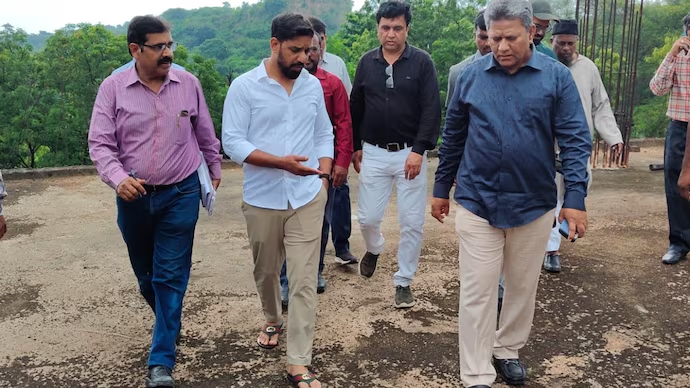
Telangana – A row has broken out in Telangana’s Shaikpet area after the Indian Army stopped construction on a piece of land allocated by the state government for a Muslim graveyard, citing defence ownership.
According to local reports, a 2,500-square-yard plot near Ghairabad Masjid in Shaikpet had been officially earmarked by the Telangana Congress-led state government for use as a Muslim graveyard. The land was meant to serve residents from areas including Borabanda, Yousufguda, Erragadda, Rahmatnagar, and Shaikpet, all within the Jubilee Hills Assembly constituency.
Within 2 hours of Congress Govt releasing GO of 2500 sq yards to Graveyard for Muslims in Jubilee Hills, Military Authorities come to take possession claiming their ownership of Land…
— Dr.Krishank (@Krishank_BRS) October 5, 2025
First Azharuddin deceived,
now Graveyard is also a Lie…
Hope Muslims realise how Revanth… https://t.co/SNIgTDOvD7 pic.twitter.com/jHItoMP5b1
On Sunday, however, a team of Indian Army officials arrived at the site and halted all activities. The officials reportedly informed local Muslim leaders that the land in question belonged to the Defence Ministry and that no civilian activity could take place there. The move effectively stopped the planned burial ground work, despite Waqf records identifying the land as community property.
Political and Religious Leaders Respond
Telangana Minorities Residential Educational Institutions Society (TMREIS) Chairman Faheem Qureshi and AIMIM MLA Kauser Mohiuddin, who were present at the site, expressed concern over the Army’s intervention. They noted that the land had been sanctioned by the Congress-led government following community appeals for adequate burial space.
The Telangana State Wakf Board, under Chairman Azmatullah Hussaini, had also recorded the land as Waqf property and initiated the process to hand it over to local Muslim representatives. However, the Army’s sudden claim has thrown the matter into dispute, leaving the Telangana government unable to enforce its own order.
Local residents say that even the allocated 2,500 square yards was insufficient to meet the area’s long-term burial needs, yet even that limited provision has now been denied. The development has sparked frustration among Muslim communities who accuse the government and the Wakf Board of failing to protect minority rights.
Growing Distrust and Broader Concerns
Opposition parties and minority rights groups have condemned the incident as insensitive and discriminatory. They argue that the Army’s intervention represents a troubling overreach, where defence claims are prioritized over constitutionally protected religious freedoms.
Community leaders say the episode has deepened mistrust toward both the civilian government and the Army, describing it as a coercive seizure of sacred land. “This is not just about a graveyard,” one local activist said. “It’s about whether Muslims in this country are allowed to practice their faith freely, even in death.”
Observers point out that this is not an isolated event. Across India, Waqf properties, religious endowments meant for community welfare, have increasingly faced legal disputes, encroachments, or administrative hurdles. The Shaikpet case, they say, is part of a wider pattern where Muslim communal rights are systematically undermined under bureaucratic or security pretexts.
A Symbol of Systemic Marginalization
The Shaikpet episode, they say, reflects a recurring issue across India: Waqf properties, historically protected for Muslim religious and communal use, are increasingly caught in legal disputes, encroachments, or bureaucratic interventions.
What was intended as a sacred provision for burial has now become a flashpoint of communal discontent. For many in Telangana’s Muslim community, the Shaikpet land dispute is more than a local conflict, it is a reminder of the growing trust deficit between India’s institutions and its largest minority, where even the right to a resting place is now contested.











