
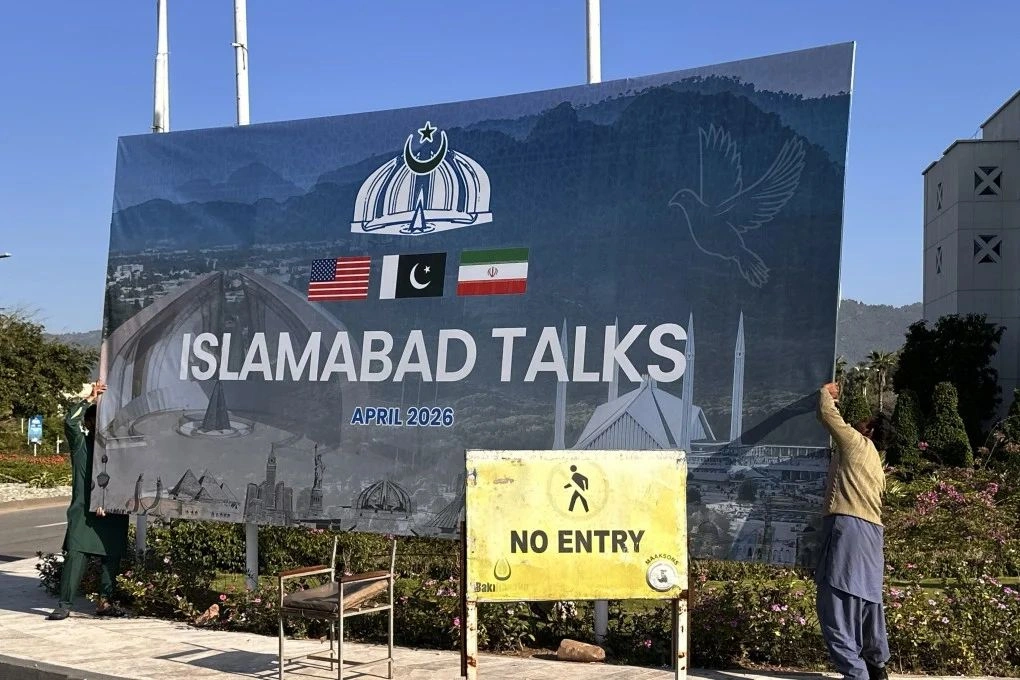
The 21-hour-long talks between the United States and Iran in Islamabad have, for the time being, failed to produce any concrete outcome. While sections of the Indian media appeared to celebrate the lack of a breakthrough, some Indian journalists took a very different stance, congratulating Pakistan on hosting the high-profile negotiations. According to them, any progress from such talks would benefit the entire world, including India.
Pakistan’s diplomatic efforts to facilitate the first high-level US-Iran engagement since 1979 attracted global attention. However, several Indian TV channels reportedly mocked the talks simply because they were held in Islamabad. This, according to critics, reflects an unprofessional and irresponsible media approach.
Senior journalist Arfa Khanum Sherwani of The Wire discussed this issue with veteran Indian journalist Nirupama Subramanian, expressing concern over the Indian media’s reaction and domestic narrative. The discussion was shared with me by Saleem Mansoor Khalid, editor of Tarjuman-ul-Quran. Interestingly, despite their ideological differences, Khalid found Sherwani’s perspective noteworthy.
Nirupama Subramanian, who previously served as The Hindu’s correspondent in Islamabad, has long experience covering Pakistan and understands its political landscape well. She has also worked with The Indian Express and other Indian publications and currently writes for The Tribune.
During the discussion, Arfa Khanum asked how Pakistan—often portrayed in Indian media as diplomatically isolated—suddenly became the center of global attention, and how US Vice President JD Vance ended up meeting Iranian parliamentary speaker Mohammad Bagher Ghalibaf in Islamabad.
Subramanian responded with an explanation that, according to Arfa, is rarely heard in Pakistani media but reflects an underlying reality. She said JD Vance was sent to Islamabad by US President Donald Trump, and that Trump’s trust in Pakistan emerged in the aftermath of India’s “Operation Sindoor.” She added that during the India-Pakistan conflict last year, Trump claimed credit for brokering a ceasefire—an assertion acknowledged by Pakistan but denied by India.
According to her, this episode brought Pakistan’s civilian and military leadership closer to Washington. Pakistan’s nomination of Trump for the Nobel Peace Prize further strengthened this relationship. As a result, Pakistan moved closer not only to China but also to the United States.
Following the May 2025 Pakistan-India conflict, when Israel and the United States reportedly targeted Iran, Pakistan condemned the strikes and maintained diplomatic balance, which, according to her, helped improve ties with Tehran. India, meanwhile, continued strengthening its alignment with Israel.
After renewed strikes in February 2026, Pakistan again attempted to mediate and push for de-escalation, eventually hosting the Islamabad talks between the US and Iran. Arfa Khanum Sherwani noted that Nirupama Subramanian’s appreciation of Pakistan’s diplomatic role was significant, highlighting that Indian media does not necessarily represent the entire Indian public opinion. Just as Pakistani media does not fully reflect every regional voice within Pakistan, Indian media also sidelines voices advocating peace.
Subramanian reportedly acknowledged the risks of speaking in favor of Pakistan’s diplomatic efforts, noting that she could face backlash from nationalist circles in India. Similar patterns, the commentary suggests, exist in Pakistan, where dissenting voices are often labeled as foreign agents.
Kashmiri leaders such as Farooq Abdullah and Mehbooba Mufti also reportedly appreciated Pakistan’s diplomatic role, a stance that has drawn criticism in New Delhi, particularly from hardline political circles.
Looking ahead, analysts suggest that if stability emerges in the Middle East, it could eventually open pathways toward resolving other long-standing disputes, including the Kashmir issue.
Since Israel is also a key actor in the regional equation, Pakistan initially focused its efforts on mediating between the US and Iran. Despite criticism from Indian media—where Pakistan was labeled everything from a “postman” to a “broker”—Islamabad’s role evolved into that of a facilitator and then a mediator.
Although the talks did not result in an agreement, US Vice President JD Vance praised Pakistan’s role before departing, while Iran accused the US of lacking flexibility. Both sides, however, engaged in 21 hours of continuous dialogue.
Pakistan is expected to continue its diplomatic efforts to bring the parties back to the negotiating table. While no agreement was reached, such negotiations often require extended timeframes, sometimes lasting weeks or months.
Data cited suggests that since 1990, over 2,000 international agreements have been signed globally, with only a small percentage fully implemented. The Doha Agreement between the US and Afghan Taliban, facilitated by Pakistan in 2020, is one such example where implementation remains incomplete.
Pakistan now hopes that the ceasefire framework can be expanded into a broader peace arrangement, potentially including other regional stakeholders such as Lebanon. Analysts argue that sustained dialogue is in the interest of all parties, particularly the United States, which despite its superpower status faces growing diplomatic challenges.
Ultimately, Pakistan’s role as a facilitator in the Islamabad talks has been acknowledged internationally, and even within sections of Indian media. Islamabad is expected to continue its efforts to transform temporary ceasefires into long-term peace frameworks.
Note: This article was written by Hamid Mir and published in Jang. All copyright rights are reserved by Jang.











