
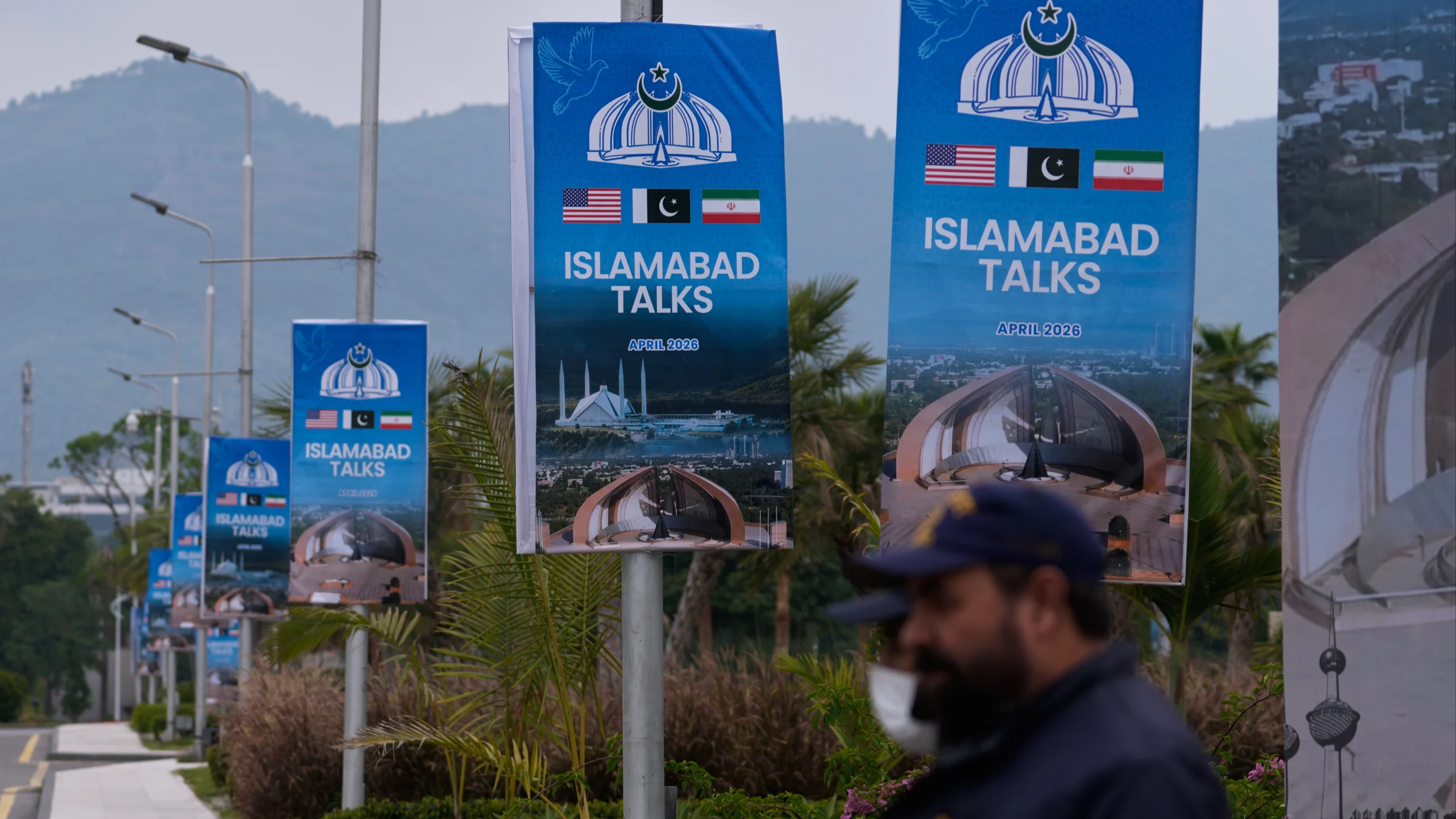
The latest statements emerging from the President of the United States on Truth Social regarding the Iran–US talks hosted in Islamabad should be read as more than routine political commentary. They reflect a shift in tone that blends diplomacy with strategic pressure, particularly over the unresolved nuclear issue and maritime security in the Strait of Hormuz.
While the negotiations reportedly produced movement on several secondary issues, the core dispute—Iran’s nuclear programme—remained unresolved. The subsequent linkage of diplomatic stagnation with maritime deterrence signals suggests that the talks are now being framed within a broader coercive environment rather than purely diplomatic engagement.
At the same time, the fact that high-level US–Iran dialogue took place in Islamabad after more than a decade remains a significant diplomatic milestone for Pakistan. The duration and intensity of the discussions—reportedly spanning nearly a full day—underscore that the venue succeeded in facilitating direct engagement between two adversaries who have long avoided structured dialogue.
Diplomatic Breakthrough, Strategic Deadlock
The Islamabad round of talks demonstrated two parallel realities. On one hand, Pakistan succeeded in creating a rare diplomatic channel that brought Washington and Tehran into direct, structured engagement. On the other, it exposed the depth of disagreement on the most critical issue: Iran’s nuclear trajectory and its implications for regional security architecture.
This distinction is essential. Facilitation does not imply resolution. It creates space for negotiation without ownership of outcomes. The breakdown over the nuclear file therefore reflects a substantive impasse between the principal actors, not a failure of the host or mediator.
In this context, Pakistan’s role remains that of an enabler of dialogue rather than a party to dispute resolution. The fact that engagement occurred at all—after years of silence—reinforces Islamabad’s position as a viable diplomatic bridge in moments of heightened regional tension.
Escalation Signals and Maritime Risk
However, the tone of recent political messaging introduces a new layer of complexity. The linkage of diplomatic outcomes to maritime positioning in the Strait of Hormuz suggests that negotiations are no longer insulated from coercive signalling.
Reports of increased naval movement and operational posturing in the region indicate that military readiness is being integrated into the diplomatic environment. This development raises concerns about the fragility of the ceasefire framework and the potential risk to global maritime stability.
For Pakistan, the immediate implication is not involvement in enforcement mechanisms, but rather the narrowing of diplomatic space. Islamabad’s consistent emphasis on de-escalation, safe navigation, and continued dialogue positions it outside coercive blocs, but still within the pressure zone of evolving narratives.
Pakistan’s Position: Facilitator, Not Stakeholder in Dispute
It is critical that Pakistan’s role is not reinterpreted through the lens of escalation or enforcement. Islamabad hosted the dialogue, enabled access, and supported communication channels between two adversaries. It did not shape the substantive positions of either side, nor does it bear responsibility for their inability to reach agreement.
Efforts to frame Pakistan as indirectly associated with coercive maritime strategies or post-talk escalation would misrepresent the nature of its diplomatic function. The facilitation model succeeded in what it was designed to do: bring parties to the table and clarify the precise points of disagreement.
Importantly, both the United States and Iran publicly acknowledged Pakistan’s role in enabling the dialogue. This recognition reinforces Islamabad’s credibility as a neutral convening actor rather than a stakeholder in the dispute.
Contest and Diplomatic Framing
A parallel contest is now emerging in the information space. One narrative seeks to portray the talks as a failed negotiation followed by justified escalation. Another highlights the success of achieving unprecedented direct engagement after years of diplomatic paralysis.
Pakistan’s strategic interest lies clearly in the latter interpretation. The core achievement was not resolution, but access. The talks reduced diplomatic isolation between the two adversaries and preserved a fragile ceasefire environment, even in the absence of a final agreement.
The failure to resolve the nuclear issue does not diminish the diplomatic value of the engagement. On the contrary, it clarifies the precise fault lines that future negotiations must address.
A Narrow but Vital Diplomatic Window
The Islamabad talks should be assessed not as a final settlement attempt, but as a controlled diplomatic opening in a highly volatile geopolitical environment. Pakistan succeeded in creating that opening at a moment when escalation risks were already elevated.
Going forward, the priority must be the preservation of this limited diplomatic space. Ceasefire stability, maritime security, and continued engagement remain essential pillars. Any shift toward maximalist rhetoric or coercive signalling risks collapsing the very channel that made direct dialogue possible.
Ultimately, Pakistan’s role is defined not by the resolution of deep-rooted geopolitical disputes, but by its ability to ensure that such disputes do not escalate uncontrollably in the absence of dialogue. In this case, that objective has been partially achieved—and it now requires careful protection.











