Pakistan stands at a critical juncture in its history, where the state is striving to ensure its survival and restore its global standing. However, in this sensitive environment, the priorities of certain influential media groups appear increasingly misaligned with the national direction.
At a time when Pakistan is emerging as a key diplomatic actor on the global stage—earning recognition for its peace-oriented approach and strategic role—concerns are growing that segments of the media are undermining this progress. Critics argue that, in pursuit of ratings and short-term gains, some outlets are amplifying narratives that run counter to national interests.
Regulatory Action Raises Questions
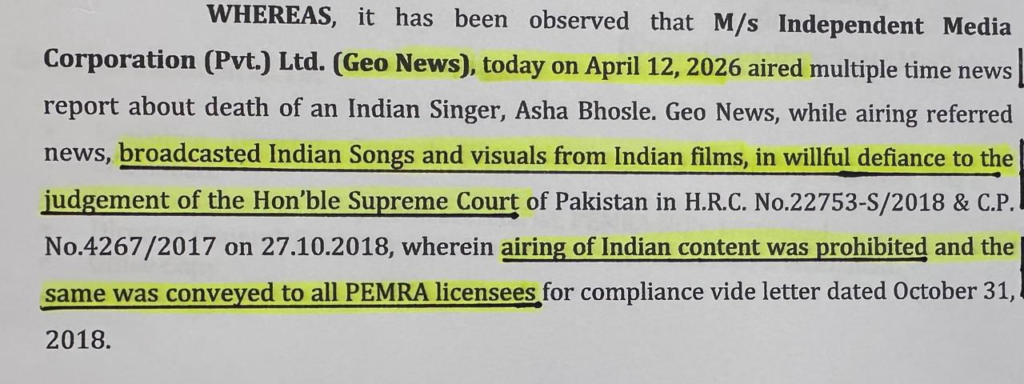
Recent action by the Pakistan Electronic Media Regulatory Authority has intensified the debate. A legal notice issued to Geo News cited a clear violation of broadcast regulations.
According to the notice, on April 12, 2026, the channel provided extensive coverage of the death of Indian singer Asha Bhosle, including the airing of Indian songs and film clips. This was deemed inconsistent with the ruling of the Supreme Court of Pakistan dated October 27, 2018, which prohibits the promotion of Indian content in Pakistan.
Questions of National Sentiment
Observers argue that, at a minimum, national responsibility would require the media to highlight security concerns and regional tensions rather than promote cultural content from a country often viewed as adversarial in political discourse.
The contrast has raised difficult questions: while Pakistani content and artists face restrictions across the border, why is space being created domestically for similar content? Critics view this as reflective of a deeper issue—what they describe as a form of “cognitive influence” or soft alignment that shapes public perception over time.
Concerns Over Undermining Diplomatic Gains
The debate has further intensified as Pakistan’s recent diplomatic engagements have drawn international praise. Analysts note that at a moment when global observers are acknowledging Pakistan’s role in facilitating dialogue and reducing tensions, certain media narratives appear to question or downplay these achievements.
Some commentators have pointed to voices within the media, including journalists like Aizaz Syed, suggesting that critical framing of diplomatic developments risks creating confusion at a time when strategic clarity is essential.
This has led to broader concerns about whether such coverage reflects healthy journalistic scrutiny or contributes to a fragmented national message during a sensitive geopolitical phase.
Cultural Influence and Information Space
Experts increasingly warn that modern conflicts are not confined to geography but extend into the cognitive and cultural domains. The promotion of foreign entertainment content, they argue, may inadvertently shape perceptions—particularly among younger audiences—creating soft influence pathways.
This raises a larger question about balance: how should media platforms weigh commercial interests against cultural and strategic considerations? The concern is that overemphasis on external content could sideline local talent and narratives that are gaining recognition globally.
Call for Responsible Media Conduct
The ongoing debate underscores the need for a more responsible and balanced media approach. Analysts stress that while freedom of expression remains fundamental, it must be exercised with awareness of broader national and societal contexts.
As Pakistan navigates a complex regional and global environment, the role of media as a “fourth pillar” becomes even more critical. Ensuring that reporting remains accurate, responsible, and aligned with broader public interest is essential—not only for maintaining credibility but also for safeguarding national cohesion.