
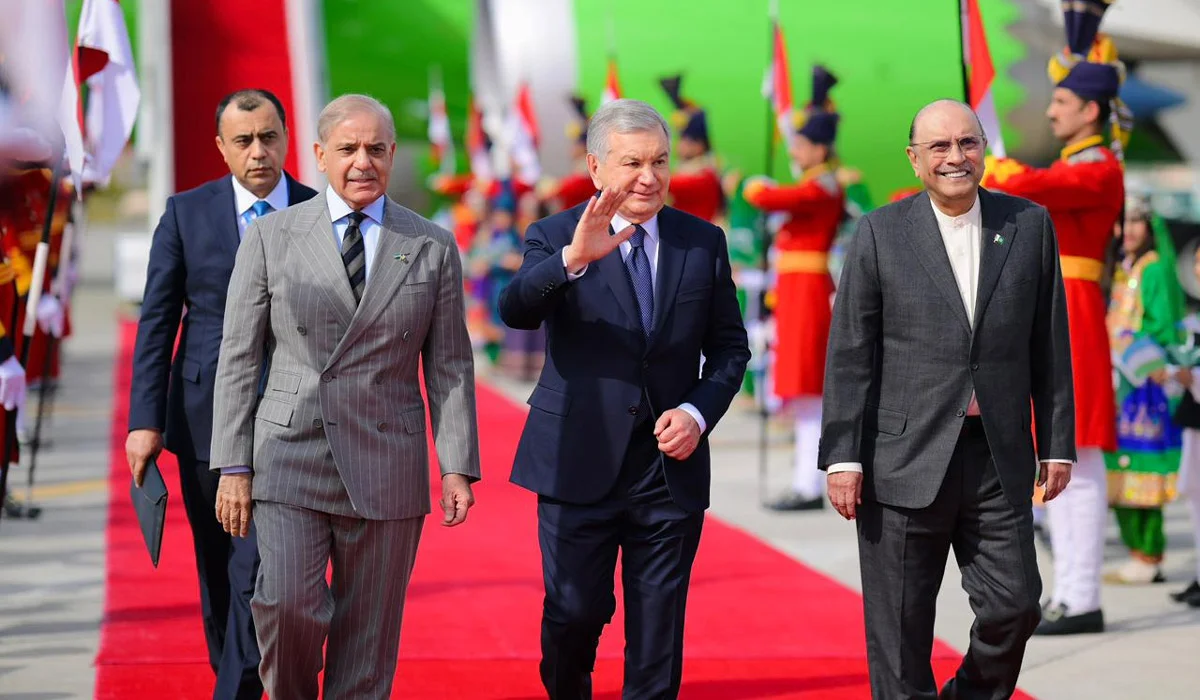
Prime Minister Shehbaz Sharif on Thursday said Pakistan would work “very closely” with Uzbekistan to advance regional connectivity, describing the Uzbekistan–Afghanistan–Pakistan Trans-Afghan Railway as a project that could transform trade and integration across South and Central Asia.
The assurance was given during a document exchange ceremony in Islamabad held in connection with the two-day official visit of Shavkat Mirziyoyev.
#Live: President of Uzbekistan Shavkat Mirziyoyev arrives in Islamabad https://t.co/hbvz6SFDIM
— Radio Pakistan (@RadioPakistan) February 5, 2026
PM Shehbaz said both countries were fully aligned on the importance of the rail link and were ready to jointly raise funds based on a feasibility study and business plan, underlining Pakistan’s commitment to making the project a reality.
Trans-Afghan railway seen as catalyst for regional trade
Addressing the ceremony, the prime minister said the proposed railway would not only benefit Pakistan and Uzbekistan but also serve the wider region by improving trade routes, reducing transport costs and linking Central Asia to Pakistani ports.
🇵🇰🇺🇿 A warm welcome to H.E. President Shavkat Mirziyoyev of Uzbekistan! President Asif Ali Zardari and PM @CMShehbaz received the @president_uz at Noor Khan Airbase today. This visit marks a significant step in strengthening bilateral ties and regional connectivity. pic.twitter.com/9F0o169Mm0
— The President of Pakistan (@PresOfPakistan) February 5, 2026
He stressed that Pakistan was prepared to offer full cooperation to move the project forward, calling it a “game changer” for regional connectivity.
PM Shehbaz highlighted Pakistan and Uzbekistan’s deep historical, cultural and spiritual ties, rooted in centuries-old links through the Silk Route. He said these shared foundations provided a strong base for expanding cooperation in trade, investment and infrastructure.
The prime minister also welcomed the signing of multiple agreements and memoranda of understanding, noting that they reflected both sides’ resolve to translate political goodwill into economic outcomes.
Broader cooperation and institutional framework
The two leaders announced the formation of a high-level working group tasked with developing a five-year roadmap covering key sectors of economic cooperation.
The group will meet regularly, with quarterly reviews to assess progress and ensure timely implementation of agreed initiatives.
🔊PR No.3️⃣4️⃣/2️⃣0️⃣2️⃣6️⃣
— Ministry of Foreign Affairs – Pakistan (@ForeignOfficePk) February 4, 2026
Curtain Raiser: Visit of the President of the Republic of Uzbekistan to Pakistan https://t.co/S1g2Llr1m2
🔗⬇️ pic.twitter.com/X2p3Xi3669
President Mirziyoyev, in his remarks, described the visit as a turning point in bilateral relations and welcomed Pakistan’s role as a bridge between Central and South Asia.
He said the Trans-Afghan Railway could unlock new opportunities for trade, logistics and investment, benefiting businesses and people across the region.
A total of 28 agreements and MoUs were signed, covering areas such as defence cooperation, agriculture, mining, climate change, disaster management and counter-narcotics.
براہِ راست: وزیراعظم اور ازبک صدر کی مفاہمتی یادداشتوں کے تبادلے کی تقریب میں شرکت https://t.co/o7AkapWqoe
— Government of Pakistan (@GovtofPakistan) February 5, 2026
Both sides also reaffirmed their commitment to expanding bilateral trade, building on recent agreements aimed at raising trade volumes to new levels.
The visit, officials said, marked the beginning of a new phase in Pakistan–Uzbekistan relations, with regional connectivity anchored by the Trans-Afghan Railway.
Read more: Pakistan and Kazakhstan Agree to Expand Trade to $1 Billion as Ties Enter New Phase











