
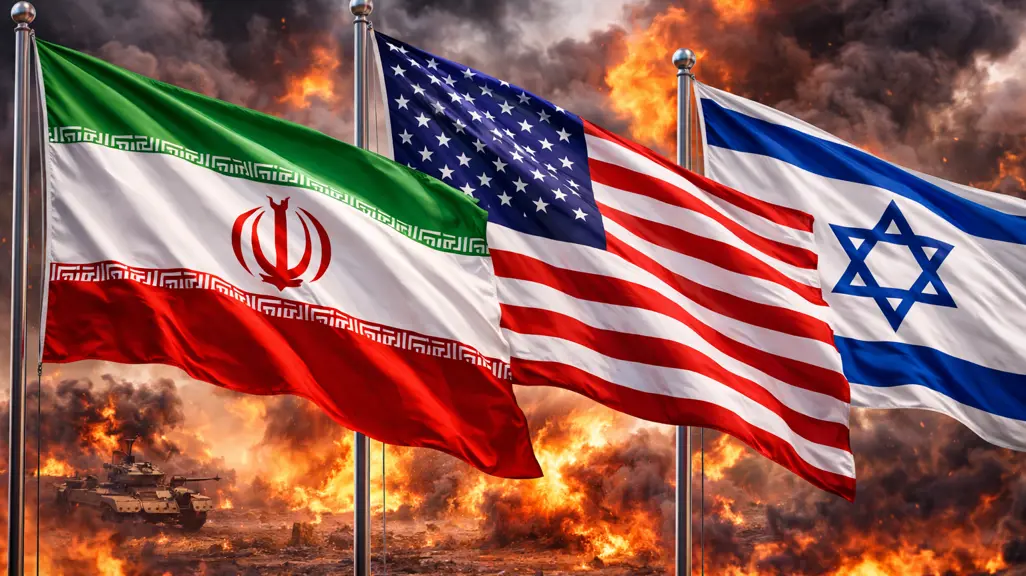
A review of the ongoing war between the three sides reveals some surprising strategic outcomes. The sun of American supremacy appears to be slowly setting, and the belief in Israel’s “invincibility” has also been broken. The technical mistake of assuming Iran to be isolated has become a source of embarrassment for the United States, while hidden allies have effectively challenged advanced military technology on the ground.
When different aspects of this trilateral war are examined, several unexpected strategic realities come forward. This analysis is not meant to support or oppose any side. Instead, it briefly looks at the strengths, weaknesses, and strategies of all parties based on current battlefield realities.
So far, one fact has become clear. The dominance of the United States is gradually declining. A superpower driven by overwhelming force has faced setbacks in this region more than once within a few years. At the same time, the image of Israel as an “unbeatable force” has also weakened.
One major technical and strategic mistake by the United States was assuming that Iran would be isolated. That assumption proved wrong. As a result, it is now facing not only Iran but also its hidden allies, who have challenged both the United States and Israel along with their advanced weapons systems.
This suggests that the war may have been poorly planned or based on misjudgment. It may also reflect a lack of seriousness or coordination in military leadership. Frequent changes in positions and resignations are being seen as signs of deeper internal issues.
Another interesting aspect of this conflict is the comparison between US, Israeli, and Indian forces. Analysts suggest that there is little difference in terms of battlefield morale. A lack of strong determination appears to be weakening their fighting spirit. In reality, all three are being described as struggling in terms of confidence and consistency.
When national narratives are shaped by fear, bias, and expansionist goals, armies often fail to fight with unity and purpose. Instead, hesitation and excuses begin to dominate.
Throughout history, different ideologies such as racial supremacy, religious extremism, political domination, and cultural superiority have all led to destruction and conflict. Whether it was Nazism, religious extremism, communism, or expansionist nationalism, the outcome has often been violence and instability.
In contrast, the concept of jihad in Islamic thought is presented by some scholars as a system based on justice and protection of human life, dignity, and rights, regardless of race, religion, or language. Its core idea is the establishment of justice rather than destruction.
From this perspective, the trilateral war is described as a struggle driven by extremist ideologies, political interests, and power competition. The cost of this conflict is being paid by innocent civilians, while its impact is being felt globally, especially in Pakistan and the wider Muslim world.
This war is also described as one where decision-making is not fully in the hands of civilian governments or institutions. Instead, control is believed to lie with those pursuing extreme or expansionist agendas, putting global peace at risk.
Another important factor in this conflict is the role of proxy forces. History shows that proxy groups are often used to weaken opponents and create pressure on the battlefield. Sometimes they cause significant damage and force retreats.
Because of this reality, some believe that regional countries may also consider building similar strategic networks for their own security interests. Pakistan, in particular, is mentioned in this context in relation to its regional rivalries.
If a ceasefire agreement is eventually reached between the three exhausted sides, it may become one of the most costly ceasefires in modern history. There may be no clear winner or loser, but each side will likely claim victory in its own way.
Whether accepted or not, the ongoing conflict between three nuclear states and one non-nuclear state has now turned into a psychological and strategic war. Some fight on the front lines, while others operate behind the scenes.
In the end, history may favor those who can maintain control over their nerves and strategy.











