
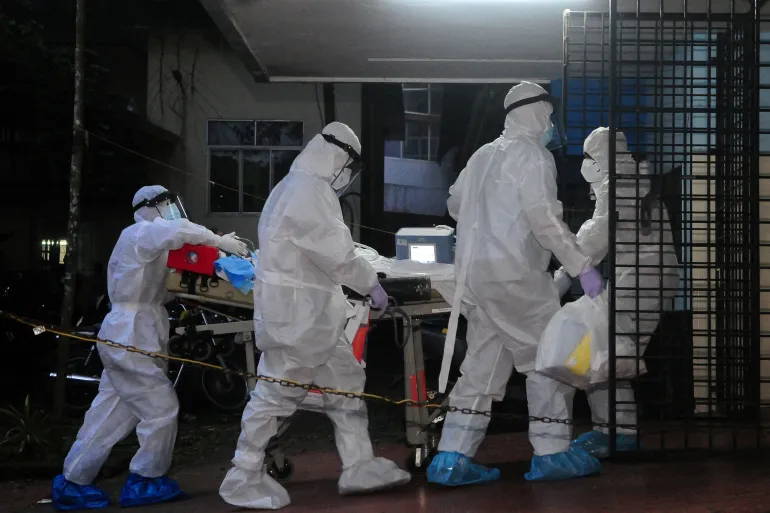
India’s claim that the deadly Nipah virus outbreak has been “contained” is raising serious questions across the region, as several Asian countries step up airport and border screening while New Delhi continues to play down the danger.
Officially, India says only two cases have been detected in West Bengal since December. But given the nature of the virus and India’s past record this reassurance is far from convincing.
Nipah is not an ordinary illness. It has no vaccine and carries a fatality rate of 40 to 75 percent, making it far more dangerous than Covid-19.
Even a small number of cases can quickly turn into a major crisis if not handled with full transparency. While India insists the situation is under control, countries including Thailand, Vietnam, Indonesia, China, Malaysia and Myanmar have already tightened screening of travelers arriving from India.
This alone shows that regional governments do not fully trust India’s claims.
More worrying are reports suggesting that the real number of infections may be higher than what is being admitted including possible hospital-linked cases in Kolkata involving healthcare workers.
If true, this would mean the virus is spreading in exactly the kind of setting where it is hardest to control.
India is downplaying a deadly risk to protect its image
The timing of India’s calm statements is also important. The country is set to host the 2026 ICC Men’s T20 World Cup, with Kolkata’s Eden Gardens listed among the venues.
There is a strong impression that the seriousness of the situation is being downplayed to protect the image of being a “safe host” for a mega sporting event.
This is not the first time concerns have been raised about health and safety standards at international events in India. During the 2026 India Open Super 750 badminton tournament, foreign players complained about filthy training halls, bird droppings, stray animals, extreme cold and toxic air.
Some players even withdrew citing safety concerns. These incidents showed that even under normal conditions, India struggles to provide basic standards for international athletes.
Why the ICC must move the world cup to Sri Lanka
Holding T20 World Cup matches near a potential outbreak zone especially of a virus as deadly as Nipah, is an unnecessary and irresponsible risk. Players, officials and fans from across the world would be exposed and any outbreak during the tournament would become a global crisis overnight.
Cricket venues cannot be treated as isolated bubbles when airports, hospitals and cities are part of the same public health environment.
Given India’s history of poor sanitation and weak event management trusting assurances alone would be reckless.
The ICC must act before it is too late and shift all T20 World Cup fixtures to Sri Lanka, where safer facilities and better health monitoring can protect both players and spectators.
Continuing in India would not only endanger lives but also send a dangerous message that money and image matter more than international safety and responsibility.
Read more: EU–India Trade Deal Raises Fears of Unequal Economic Partnership











