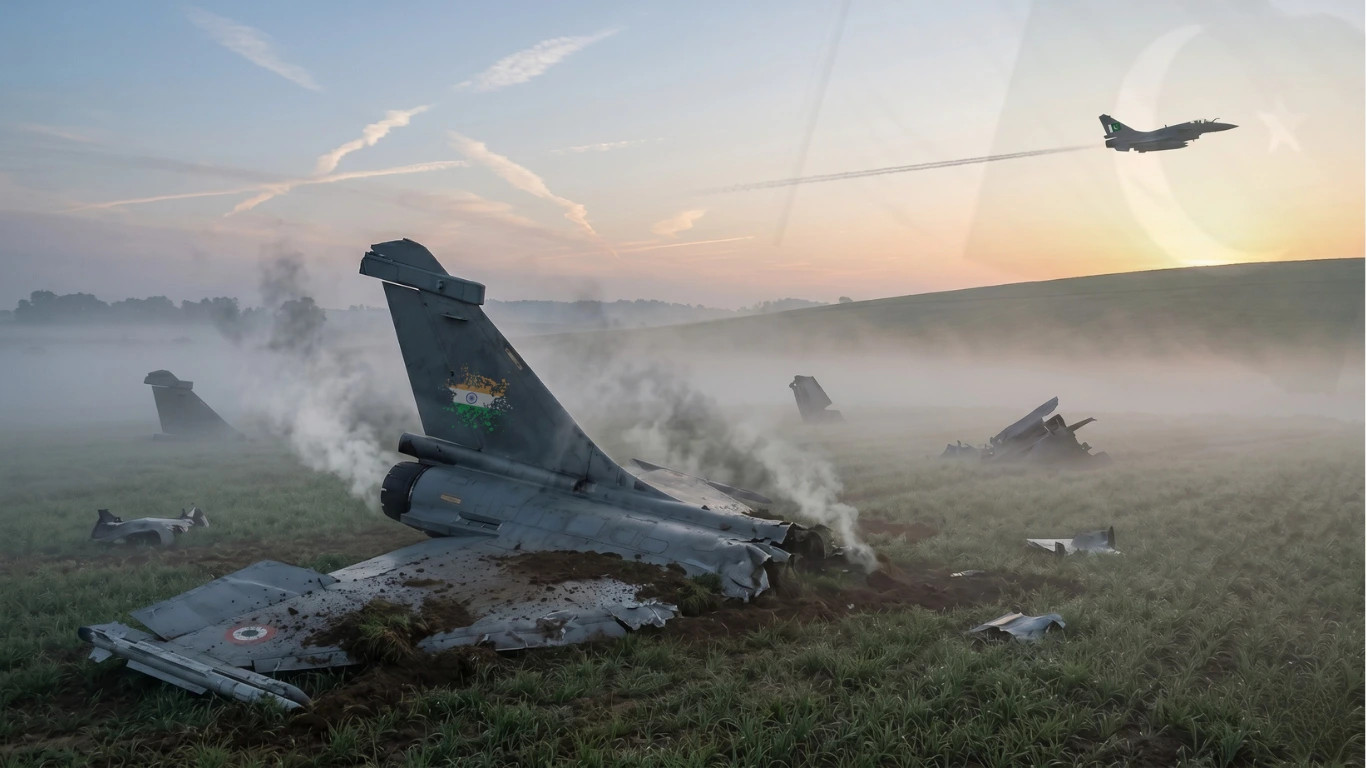
There is a kind of arrogance that comes with buying the world’s most celebrated fighter jet. India signed a $6 billion deal for 36 Rafales in 2016, spent years parading them at air shows, and entered the night of May 7, 2025 convinced that French engineering and Western prestige would translate into aerial dominance over Pakistan. Between 1:05 and 1:30 a.m. that same night, India fired missiles at 6 Pakistani cities and hit mosques. Within the next 52 minutes, Pakistan’s Air Force had answered. What happened in those 52 minutes is what the world spent the next several months trying to piece together, and what India spent the next several months trying to suppress.
What the Skies Recorded on May 7
The aerial engagement on the night of May 6 and 7 involved over 114 aircraft; 72 Indian, 42 Pakistani, in what defence analysts called the largest beyond-visual-range air battle since the World War. Not a single Pakistani aircraft crossed the international border. Every jet stayed in its own airspace. Pakistan fired longer, thought clearer, and executed with a discipline that no one in New Delhi had apparently war-gamed for. By the time the engagement ended, six Indian jets had been downed within a 40-minute span: 3 Rafales, 1 Su-30MKI, 1 Mirage 2000, and 1 MiG-29. Confirmed by Air Vice Marshal Aurangzeb Ahmed, he famously summarized the outcome as a “6-0” victory for Pakistan
What France and America Confirmed
India stayed quiet and hoped the world would too. Air Marshal A.K. Bharti stood at a press conference on May 11 and offered the world one sentence: “We are in a combat situation and losses are a part of combat”, before refusing to name a single platform, number, or tail fin. The world had already found the tail fins. French Air Force Chief General Jérôme Bellanger told the Associated Press that he had seen evidence of three Indian aircraft losses: 1 Rafale, 1 Sukhoi, and 1 Mirage 2000. He confirmed this was the first-ever combat loss of the Rafale in its 20-year operational history across 8 countries. The Washington Post independently verified debris consistent with at least two French-made jets: a Rafale at Akalia Kalan near Bhatinda and a Mirage 2000 at Wuyan in Pampore. Then came the American president himself. On July 18, 2025, Donald Trump told Republican lawmakers at the White House: “Planes were being shot out of the air. Five, five, four or five, but I think five jets were shot down, actually.” Bloomberg confirmed the remarks. Al Jazeera confirmed the remarks. India had no answer except silence.
Credit Where It Belongs: The JF-17 and the J-10C
This is the part that the Western defence establishment found most uncomfortable to write. The J-10C and the JF-17 Thunder are products of a partnership that Western arms manufacturers spent years dismissing as derivative and unproven. One conflict changed that permanently. The engagement marked the first-ever combat use of the Chinese PL-15 long-range air-to-air missile, and if confirmed fully, the first combat kill of a Rafale by a Chinese-origin aircraft. Defence markets felt the verdict instantly. Dassault Aviation’s stock fell on the Paris Stock Exchange the morning the news broke. Indonesia, which had been considering Rafale purchases, began conversations about the J-10C. Captain Jacques Launay, a French naval commander who has flown Rafales for 25 years and commands a base with over 40 nuclear-armed Rafales, told an international Indo-Pacific conference that Pakistan was simply better prepared on the night. When an Indian delegate interrupted him to call it disinformation, Launay ignored the remark and continued
What Restraint Actually Looks Like
After the air battle of May 7, Pakistan absorbed two more days of Indian drone incursions and cross-border shelling while the National Security Council deliberated. Pakistan intercepted Indian drones sent on May 8, and endured tit-for-tat strikes on the night of May 9 and 10 before the full weight of Operation Bunyan-ul-Marsoos came down. 26 military targets. 15 Indian airbases. 2 S-400 systems neutralised. BrahMos storage facilities at Beas and Nagrota destroyed. Zero civilian sites touched. That is what strategic patience looks like when a military actually means it. India brought $6 billion worth of French engineering to this fight. Pakistan brought preparation, restraint, and pilots who knew precisely what they were doing. One year on, the wreckage is still on Indian soil, and the question of how many Rafales were lost still has no honest answer from New Delhi. Pakistan never needed them to admit it.
Read More: Afghanistan Risks Fragmentation if Taliban Rule Continues, Warns Dr Maria Sultan