
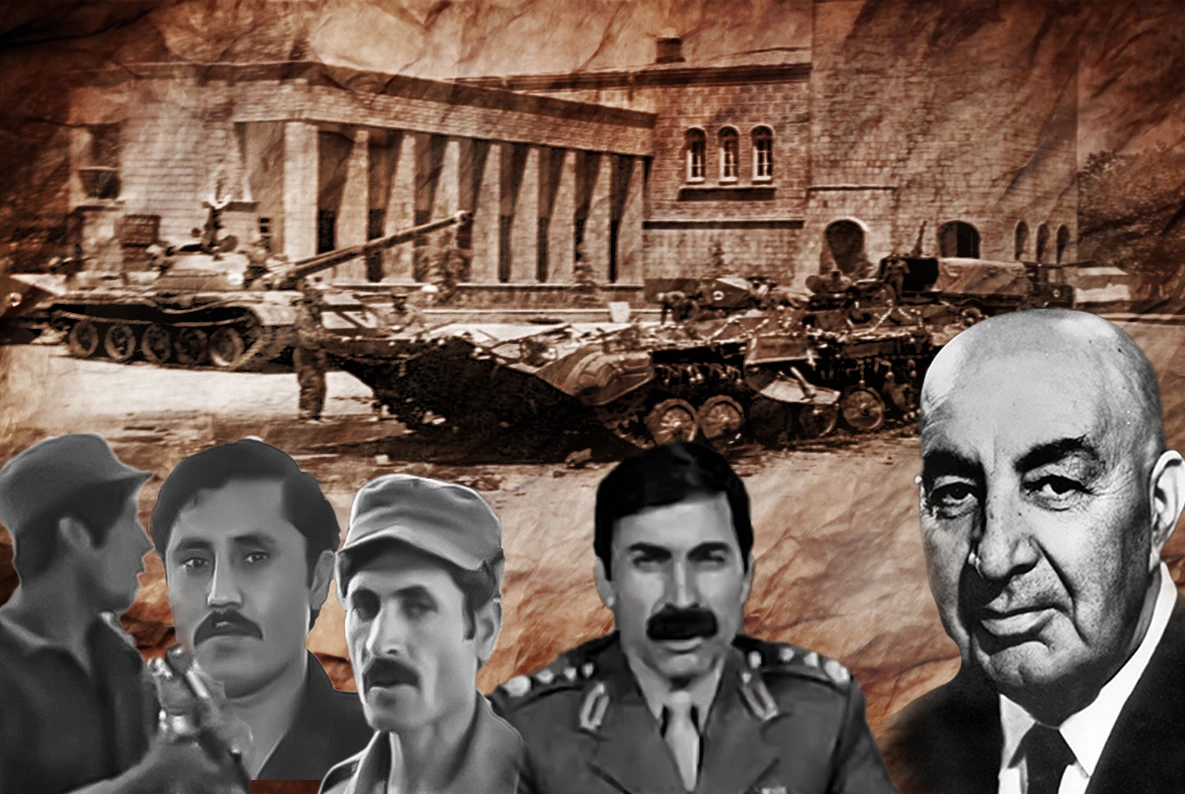
48 years ago today, a group of military officers in Kabul ended a presidency, a family, and what remained of Afghanistan’s fragile political order. Sardar Mohammad Daoud Khan, the first President of Afghanistan, was killed in a violent military coup which began on April 27, 1978. The coup was led by the Soviet-backed People’s Democratic Party of Afghanistan (PDPA). What they inaugurated was a cycle of governance-by-force the country has never broken free of.
The Spark That Lit the Powder
The immediate trigger for the revolution had come on April 17, 1978, when Mir Akbar Khyber, a prominent Parcham ideologue, was assassinated in Kabul. The PDPA blamed the government. Khyber’s funeral on April 19 transformed into a massive demonstration, with thousands of PDPA supporters marching through Kabul’s streets. Alarmed, Daoud’s government responded with a crackdown, arresting most of the PDPA’s senior leadership in the days that followed. That crackdown sealed his fate.
A Republic That Consumed Itself
The Saur Revolution overthrew President Mohammad Daoud Khan, who had himself come to power in a 1973 coup by deposing his cousin, King Mohammad Zahir Shah. Daoud legitimised the gun as a tool of succession, and the gun returned for him five years later. Among the young officers stationed at the historic Bala Hissar fortress that day was Shahnawaz Tanai, a Soviet-trained special forces officer who had received secret orders to topple Daoud Khan’s republican government. Three paratroopers from Shahnawaz Tanai’s Commando Unit entered the Arg palace on April 28 and killed Daoud along with 17 members of his family. US diplomatic cables later confirmed that Daoud was repeatedly urged to swear loyalty to the coup’s council. He refused. Afghanistan’s first president died having governed a state he never quite built.
Pashtunistan Obsession That Weakened the State
Daoud’s central failure was mistaking an obsession for a strategy. From the moment he returned to power, he reinvigorated the Pashtunistan issue, provided weapons and shelter to Baloch insurgents and Pakistani Pashtun nationalists, and because he could not sell this policy to Iran, the Arab world, or the United States, leaned far more heavily than his country could afford on Moscow. A government consumed by redrawing someone else’s map has no attention left for its own house. His economic plans stalled, his one-party constitution turned allies into enemies, and his oreign policy gave the Soviets the opening they needed.
The Cold War Powers Who Finished the Job
Afghanistan was not only undone by its own political class. As research at Stanford’s Hoover Institution has documented, neither superpower had grand designs for Afghanistan as late as 1977, the country’s last genuinely peaceful year. The 1978 coup changed that, pulling both powers into a competition driven more by fear than by facts. By 1979, a series of tit-for-tat superpower interventions had destabilised the country entirely, leaving it engulfed in a full-scale civil war between an unpopular communist government and Islamist guerrilla forces. The Cold War did not create Afghanistan’s governance failures, but it ensured those failures became catastrophic.
What the Revolution Actually Delivered
What followed the coup was far darker than the coup itself. Between April 1978 and the assassination of Taraki in October 1979, Khalqists murdered more than 50,000 Afghans in a campaign of political terror, with more than 27,000 killed in Pul-e-Charkhi prison alone. The ideological program that the PDPA imposed, land confiscations, forced secularisation, the dismantling of traditional social structures, triggered revolts across the countryside almost immediately. Afghanistan was not ready for a revolution imported from Soviet textbooks, and the countryside made that clear with blood.
History on Repeat
The 7th of Saur earns its relevance today because the same governing pathology has reproduced itself with precision. The Taliban’s ambiguity on the Durand Line and their consistent refusal to act against the Tehrik-i-Taliban Pakistan mirror Daoud’s calculation exactly: the Pashtun question is more valuable as leverage than as a problem to resolve.
The governance picture is just as grim. Afghanistan’s economy has shrunk by nearly 30% since 2021, over 500,000 jobs have been lost, and 75% of the population cannot meet its basic daily needs. About 2.5 million Afghan girls, representing 80% of school-age girls, are today denied their right to education. A government that strips half its population of economic participation and learning has chosen the consolidation of control over the construction of a state. Daoud made a version of that same choice. Every Afghan government since 1978 has fallen to a variation of the same failure: power seized before governance was considered, territorial provocation preferred over diplomatic patience, and ideology used as a costume rather than a conviction.
48 years on, the questions the 7th of Saur raised about who governs Afghanistan, for whom, and toward what end, remain as unanswered as they were on the morning of April 28, 1978.
Read More: The One-Way Street of Subcontinental Grief











